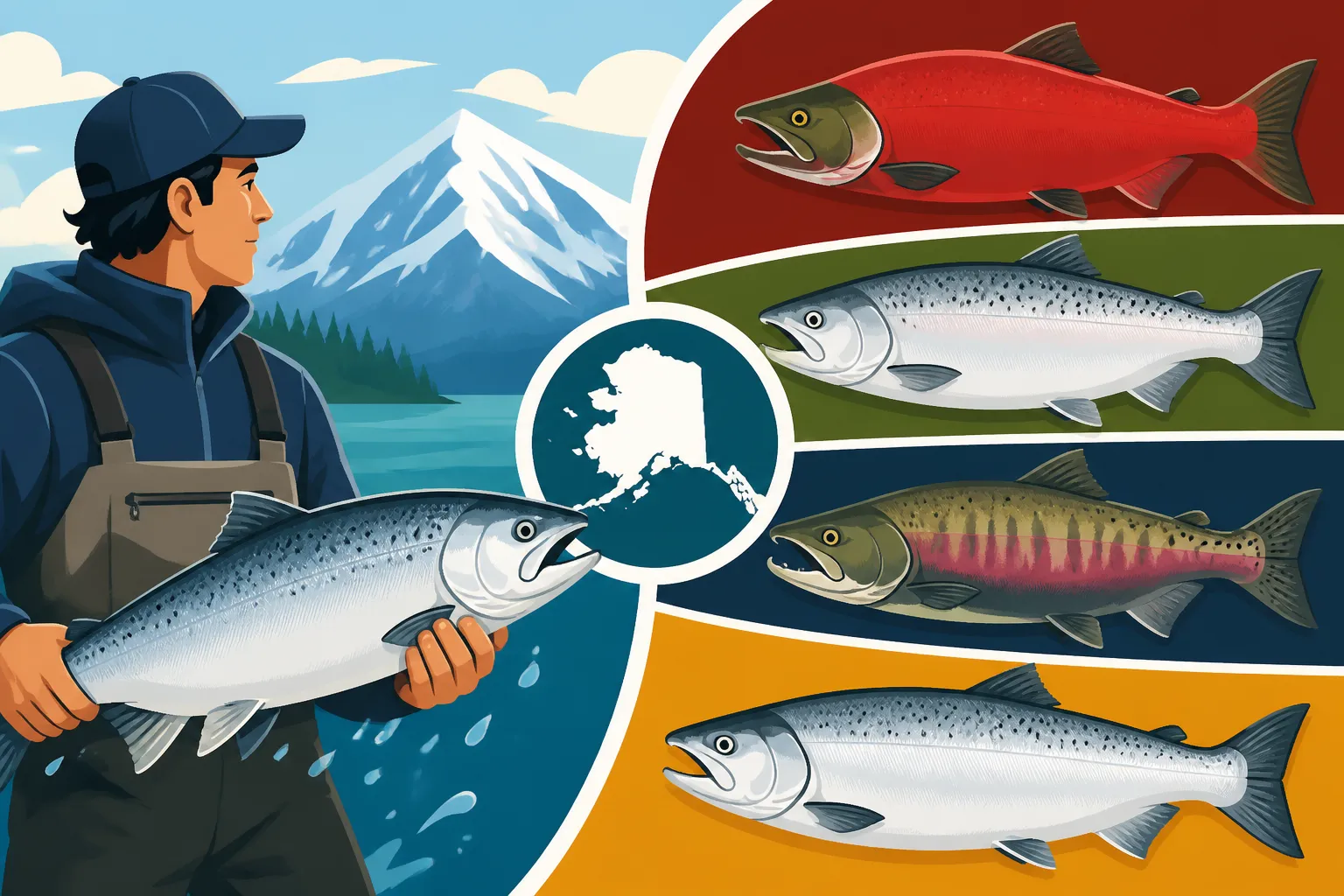
How to Identify Alaska Salmon Species
Stepping onto an Alaskan riverbank or the deck of a saltwater charter, it's easy to get swept up in the excitement, but then the confusion hits: "Is that a King? Or a Coho? What about that one with the spots?" Mistaking one salmon species for another is a common frustration, and it can have real consequences for your fishing trip and even the resource. This guide is here to walk you through the distinct features of Alaska's magnificent salmon species, helping you confidently identify your catch and ensure you're always fishing within the rules.
Why Identifying Alaska Salmon Species Matters More Than You Think
Many anglers, especially those new to Alaska, might think "a salmon is a salmon." But out here, that couldn't be further from the truth. Knowing your species isn't just about bragging rights; it’s fundamental to ethical fishing, adhering to regulations, and even enjoying the best culinary experience. Imagine planning your dream trip to the Kenai River for sockeye, only to realize you've been targeting a different species entirely. The subtle distinctions matter, and understanding them enhances every aspect of your Alaskan fishing adventure.
Fishing Regulations and Bag Limits
Alaska has some of the most intricate and dynamic fishing regulations in the world, and they vary significantly by species, location, and time of year. For instance, the daily bag limit for King Salmon is often much stricter than for Pink Salmon, and a King Salmon Stamp might be required. Imagine reeling in a beautiful salmon on the Kenai River. Is it a King, a Coho, or a Sockeye? Each has different legal size limits, annual limits, and often even different methods of retention. If you mistakenly keep a King Salmon when the limit for that specific species or river is closed, or if you exceed your daily quota for Alaska Salmon Bag Limits by Species, you could face hefty fines, confiscation of your catch, or even a ban from fishing. Understanding these rules is critical not just to stay out of trouble but to actively participate in the conservation efforts that keep Alaska's fisheries thriving.
Enforcement officers are diligent, especially in popular spots like the Russian River or the Kasilof River, and "I didn't know" is rarely an acceptable defense. Many rivers have specific rules for certain species, like the often-changing regulations for King Salmon on the Susitna River. Knowing how to identify each species empowers you to quickly and accurately determine if your catch is legal to keep, whether it requires a special stamp, or if it needs to be released immediately. This knowledge is your first line of defense against unintentional violations and ensures you're a responsible angler contributing to sustainable fishing practices for future generations. For a broader understanding of all the rules, check out our guide to Alaska Fishing Regulations Explained.
Taste and Culinary Uses
Let's be honest, a big part of the Alaska fishing experience is enjoying the fruits of your labor! But not all salmon are created equal when it comes to the dinner plate. Each species boasts a unique flavor profile, fat content, and texture, making some ideal for grilling, others for smoking, and some perfect for a simple pan-fry. A King Salmon, for example, is renowned for its rich, buttery flavor and high omega-3 content, making it a top choice for a special occasion meal. Sockeye salmon, with its vibrant red flesh and firm texture, is excellent for grilling or baking and holds up beautifully to stronger marinades.
On the other hand, a Pink Salmon, while abundant and delicious when fresh, has a milder flavor and lower fat content, often making it a popular choice for canning or smoking. Chum salmon, sometimes unfairly maligned, can be fantastic when caught fresh and handled well, offering a firm texture that is great for jerky or certain Asian-inspired dishes. Knowing which species you've landed allows you to properly prepare and appreciate your catch, ensuring you get the most out of your hard-earned fish. It's like the difference between a prime rib and a lean chicken breast – both delicious, but best prepared in their own way.
Conservation and Stewardship
Beyond personal enjoyment and legal compliance, accurate salmon identification plays a crucial role in the broader conservation and stewardship of Alaska's invaluable fisheries. Fisheries management relies heavily on accurate harvest data, and misidentifications can skew these statistics, leading to incorrect management decisions. If anglers are consistently misreporting their catches, it becomes harder for the Alaska Department of Fish and Game (ADF&G) to assess population health, set appropriate bag limits, and implement necessary protections, such as emergency closures.
For instance, if you're targeting hatchery-born Coho Salmon, which might have higher retention limits, but you accidentally keep a wild Coho from a struggling run, you're inadvertently impacting the wild population. Furthermore, reporting your harvest correctly on your Alaska Harvest Record Card Explained is vital. This card is a critical tool for fisheries biologists to track angler effort and success for various species. By accurately identifying and recording your catches, you're directly contributing to the scientific data that informs sustainable fishing practices, helping to protect these incredible fish for future generations of Alaskans and visitors. It's a responsibility every angler shares when fishing in this pristine wilderness.
The Five Pacific Salmon of Alaska: A Quick Overview
Alaska is truly the salmon capital of the world, hosting all five species of Pacific salmon. Each species brings its own unique characteristics, migratory patterns, and culinary delights. While we'll dive deeper into identification specifics later, let's start with a brief introduction to the main players you'll encounter in Alaska's waters. Understanding these fundamental differences is the first step in becoming a proficient salmon identifier. You can learn more about these fascinating fish in our general Types of Salmon in Alaska Explained guide.
King Salmon (Chinook)
The King Salmon, also known as Chinook, is the largest and arguably most coveted of the Pacific salmon species. These magnificent fish are true giants, often exceeding 30 pounds, with some reaching over 70 pounds! They are known for their powerful fights and rich, fatty flesh. When fresh from the ocean, their bodies are often silver with a slightly blue or greenish hue on their backs. They are distinguishable by their black spots on both lobes of the tail and along their back, as well as their characteristic black gums and mouth interior.
King Salmon typically embark on the longest and most arduous migrations of all salmon, traveling hundreds or even thousands of miles upriver to their spawning grounds. They are often the first salmon species to return to freshwaters in late spring and early summer, though some winter-run Kings are also found. Their sheer size and incredible fight make them a premier target for anglers, particularly in legendary rivers like the Kenai and Deshka. Finding these impressive fish requires specific techniques and a keen understanding of their habits, as detailed in our Alaska King Salmon: Complete Guide.
Sockeye Salmon (Red)
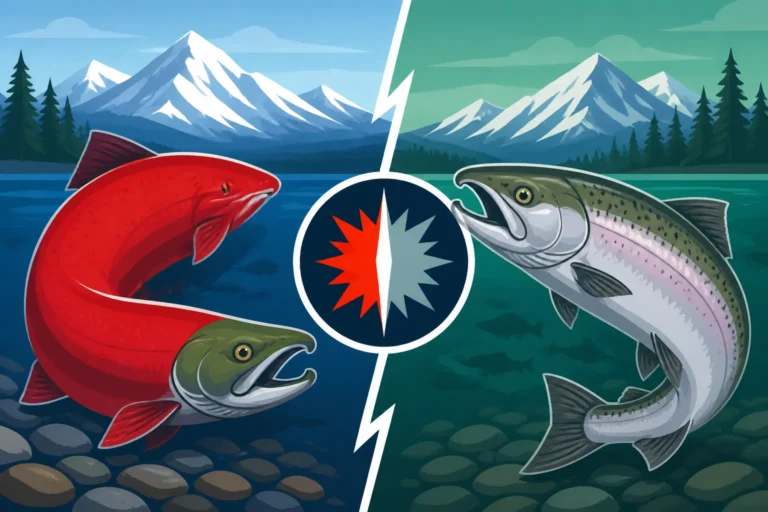
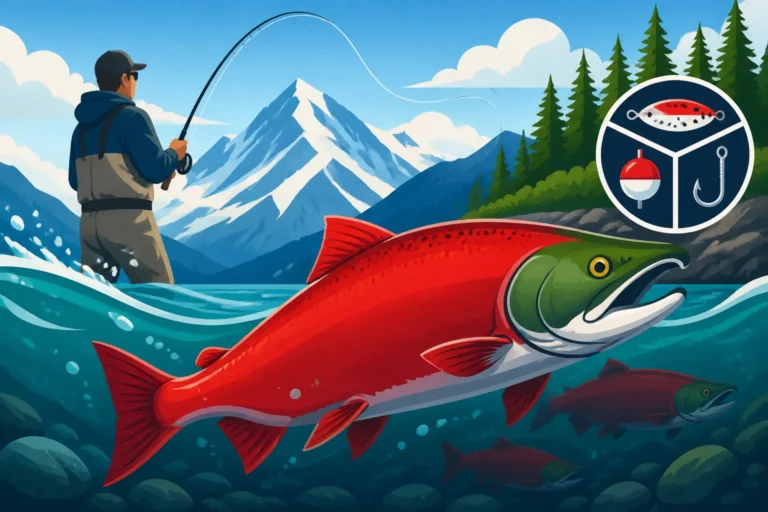
Sockeye Salmon, or Reds, are famous for their brilliant red spawning coloration and their delicious, firm, bright orange-red flesh. While not as large as Kings, they are incredibly strong fighters, especially in river currents. Ocean-bright Sockeye are predominantly silver with a metallic blue-green back and typically lack significant spotting on their backs or tails. Their most distinctive feature, even when ocean-bright, is their white gums and relatively small, conical teeth.
Sockeye salmon are unique among Pacific salmon because they feed primarily on zooplankton in the ocean, which contributes to their distinctive flesh color. This feeding habit also means they are notoriously difficult to catch on traditional lures or bait once they enter freshwater; most river fishing for Sockeye involves "flossing" or targeting their instinct to react to objects passing near their mouths. Rivers like the Kenai River and the Russian River are world-renowned for their massive Sockeye runs, often drawing thousands of anglers during peak season. You can explore more about these fish in our Alaska Sockeye Salmon Explained article.
Coho Salmon (Silver)
Coho Salmon, affectionately known as Silvers, are celebrated for their acrobatic fights and aggressive takes on lures and flies, particularly in the late summer and fall. They are medium-sized salmon, typically ranging from 8 to 15 pounds, though larger individuals can be found. Ocean-bright Coho are sleek and silver with a distinct metallic blue-green back, similar to Kings. A key differentiator is their black spots primarily on the upper lobe of the tail and along the back, and critically, their white gums, although their mouth interior can be dusky.
Coho salmon are often highly accessible in both saltwater nearshore areas and freshwater rivers and streams. They are excellent targets for both spin fishing and fly fishing, readily chasing a variety of lures, flies, and cured eggs. They provide fantastic sport fishing throughout much of Alaska, including the coastal waters near Seward and Valdez, and rivers like the Kasilof and Susitna. Their energetic runs and jumps make them a favorite among many anglers. Dive deeper into these feisty fighters with our Alaska Coho Salmon: Facts and Fishing Tips.
Pink Salmon (Humpy)
Pink Salmon, or Humpies, are the most abundant species of Pacific salmon and are easily recognizable, especially during their spawning phase. They are the smallest of the Pacific salmon, typically weighing between 3 and 5 pounds. Ocean-bright Pinks are bright silver with a blue-green back and are distinguished by their very large, oval-shaped black spots on their back and entire tail, which are much more pronounced and numerous than on Kings or Cohos. Another unique feature is their incredibly small scales.
As they approach spawning, males develop a dramatically humped back – hence the "Humpy" nickname – and their coloration shifts to mottled green, brown, and pink. Pinks have a two-year life cycle, meaning strong runs occur every other year in many systems, with even-numbered years often seeing larger returns in Southcentral Alaska, for example. While their culinary reputation sometimes lags behind Kings and Sockeye, fresh Pinks can be delicious, especially when caught early in their run. They offer fast-paced action and are a great option for beginner anglers or families. For more detailed insights, check out Alaska Pink Salmon: Facts and Fishing Tips.
Chum Salmon (Dog or Keta)
Chum Salmon, also known as Dog Salmon or Keta Salmon, are robust fish, typically weighing 8 to 15 pounds, though some can grow significantly larger. When ocean-bright, they are silvery with faint, irregular vertical bars or stripes often appearing on their sides. Their tail is usually unspotted and has a broad, blunt shape. Their most distinct feature is their white gums and the absence of spots on their tail.
As they enter freshwater and approach spawning, Chum salmon undergo a dramatic transformation. Their bodies take on distinct vertical bars of green, purple, and red, and males develop impressive, canine-like teeth (giving them the "Dog Salmon" moniker) and a slightly humped back. This unique spawning coloration makes them relatively easy to identify in rivers. Chum salmon are known for their powerful fight and are often targeted for their roe, which is highly prized as bait or for human consumption. While often considered less desirable for eating fresh than Kings or Sockeye, their firm flesh is excellent for smoking or canning. Learn more about these formidable fish in our Alaska Chum Salmon: Facts and Fishing Tips.
Unpacking Key Identification Features: What to Look For
So, you've got a fish on the line! Now comes the critical moment: how do you tell what kind of salmon it is? It can be tricky, especially with ocean-bright fish that haven't developed their full spawning colors yet. But don't worry, there are several key anatomical features that, once you know what to look for, make identification much easier. It's like being a detective, examining clues to solve the mystery.
Mouth, Gums, and Tongue Color
This is perhaps the single most reliable and often overlooked identification feature, especially when dealing with chrome-bright salmon fresh from the ocean. You need to carefully open the fish's mouth and inspect its gums and tongue.
- King Salmon (Chinook): The absolute tell-tale sign of a King Salmon is that both its gums (the fleshy area inside the mouth along the jawline) and the interior of its mouth will be entirely black or very dark. This feature is consistent across all sizes and life stages, from a small feeder King to a massive spawning behemoth. If you see a mouth full of black, you've got a King.
- Sockeye Salmon (Red): Sockeye have entirely white gums and a white or very pale mouth interior. Their teeth are also generally smaller and more conical compared to Kings or Chums.
- Coho Salmon (Silver): Coho also have white gums, but their mouth interior can often be dusky or dark along the jawline, though not entirely black like a King. This can be a point of confusion, so always check the gums first. If the gums are white, it’s not a King.
- Pink Salmon (Humpy): Pink Salmon have white gums and a white or very pale mouth interior, similar to Sockeye. Their teeth are small.
- Chum Salmon (Dog/Keta): Chum Salmon also have white gums and a white or pale mouth interior. As they approach spawning, males can develop very prominent, dog-like teeth, which is a key characteristic, but their gums will remain white.
Getting a clear look at the gums is crucial. If you're on a charter, your captain or deckhand will likely point this out immediately, as it's the fastest way to differentiate between Kings and other species like Coho or Chum.
Tail Shape and Spotting Patterns
The tail (caudal fin) and the pattern of spots on the back and tail are another critical set of clues. This feature requires a good visual inspection of the whole fish.
- King Salmon (Chinook): King Salmon typically have a broad, slightly forked or squared tail. The most important spotting characteristic is the presence of irregularly shaped black spots on both the upper and lower lobes of the tail. They also have spots on their back, often extending onto the adipose fin.
- Sockeye Salmon (Red): Sockeye have a deeply forked tail with a slender caudal peduncle (the narrow part of the body leading to the tail). Crucially, Sockeye salmon rarely have any significant spots on their tail or back. If you see a salmon with a forked tail and no spots, it's very likely a Sockeye.
- Coho Salmon (Silver): Coho usually have a slightly forked or squared tail. They have distinct black spots, but these are primarily found on the upper lobe of the tail, although they may occasionally have a few faint spots on the lower lobe. They also have spots on their back, often extending onto the dorsal fin.
- Pink Salmon (Humpy): Pink Salmon have a slightly forked or squared tail. Their most striking feature is the presence of very large, oval-shaped black spots on their entire tail (both lobes) and along their back. These spots are typically much larger and more numerous than those found on Kings or Cohos.
- Chum Salmon (Dog/Keta): Chum Salmon have a broad, relatively blunt, and slightly forked or squared tail. Their tail is almost always completely unspotted. They may have very faint, sparse speckling on their backs but lack the distinct spots of Kings, Cohos, or Pinks.
When you're comparing a King and a Coho, the tail spotting is a key identifier after the gums. If you see spots on both lobes, it's a King. If mostly on the upper lobe, it's a Coho.
Body Shape, Size, and Coloration
While less definitive for ocean-bright fish, the overall body shape, typical size, and coloration can provide strong supporting evidence for identification, especially as fish mature and begin their spawning migrations.
- King Salmon (Chinook): The largest and most robust of the salmon species. Ocean-bright Kings are deep-bodied, powerful, and typically have a metallic silver body with a darker, sometimes bluish or greenish, back. As they approach spawning, their color darkens to olive-brown, copper, or reddish, and males develop a moderate kype (hooked jaw).
- Sockeye Salmon (Red): Sockeye are torpedo-shaped and very streamlined. Ocean-bright Sockeye are bright silver with a distinct blue-green back. In freshwater, they undergo a dramatic transformation: their bodies turn a brilliant red, and their heads become greenish, sometimes with a whitish lower jaw. Males develop a slight hump.
- Coho Salmon (Silver): Coho are sleek and somewhat slender, but still powerful. Ocean-bright Coho are very silvery with a darker, bluish-green back. As they mature in freshwater, their coloration changes to a darker red or maroon on their sides, with a dark green head. Males develop a more pronounced kype than Sockeye, but less than Kings.
- Pink Salmon (Humpy): Pinks are the smallest of the Pacific salmon. Ocean-bright Pinks are bright silver with a blue-green back. As they enter freshwater, males develop a dramatically humped back (hence "humpy") and a pronounced kype, and their coloration becomes mottled green, brown, and pink.
- Chum Salmon (Dog/Keta): Chum are typically deep-bodied and somewhat less streamlined than Sockeye or Coho. Ocean-bright Chums are silvery with faint, irregular vertical bars. In freshwater, they develop striking vertical bars of green, purple, and red, and males grow large, intimidating canine-like teeth and a slight hump.
Remember that coloration can vary depending on where and when the fish was caught. A salmon caught in saltwater will be much brighter and silver than one caught far upriver that has been staging for spawning for weeks.
Fin Characteristics
While not as distinctly unique as mouth color or tail spots, observing the fins can offer additional clues.
- Dorsal Fin: The main dorsal fin on all five species is single and relatively soft-rayed. Look at its position and general size relative to the body.
- Adipose Fin: All Pacific salmon have a small, fleshy adipose fin between the dorsal fin and the tail, similar to trout. This is generally not a distinguishing feature between salmon species, but its presence confirms it's a salmonid.
- Pectoral and Pelvic Fins: These fins are generally proportionate to the fish's size.
- Anal Fin: Located behind the vent. The number of rays can sometimes be used by experts for identification, but it's not a practical field ID for most anglers.
- Scales: While not a "fin," scale size can be a clue. Pink Salmon, in particular, have notably small scales compared to other salmon species. You might even notice this when handling the fish.
While fin characteristics might not be the primary identifier, they can serve as a reinforcing clue. For instance, the very small scales of a Pink Salmon, combined with its large spots and humped back, form an unmistakable profile.
Here's a handy table to help summarize the primary distinguishing features:
| Feature | King Salmon (Chinook) | Sockeye Salmon (Red) | Coho Salmon (Silver) | Pink Salmon (Humpy) | Chum Salmon (Dog/Keta) |
|---|---|---|---|---|---|
| Gums | Black | White | White | White | White |
| Mouth Interior | Black/Dark | White/Pale | Dusky/Dark along jaw (not all black) | White/Pale | White/Pale |
| Tail Spots | Spots on both lobes | No/Very few spots | Spots primarily on upper lobe | Large, oval spots on entire tail | No/Very few spots |
| Body Spots | Spots on back, often to adipose fin | No/Very few spots | Spots on back, often to dorsal fin | Many large spots on back | No/Very faint speckling |
| Body Shape | Large, deep-bodied, powerful | Torpedo-shaped, slender | Sleek, medium-bodied | Smallest, humped back (spawning ♂) | Robust, deep-bodied, strong |
| Color (Ocean) | Metallic silver, dark blue/green back | Bright silver, metallic blue-green back | Bright silver, blue-green back | Bright silver, blue-green back | Silvery, faint vertical bars/stripes |
| Color (Spawn) | Olive-brown/copper, reddish | Brilliant red body, green head | Red/maroon sides, dark green head | Mottled green/brown/pink, large hump (♂) | Green/purple/red vertical bars, large teeth (♂) |
| Scales | Normal | Normal | Normal | Very small | Normal |
A Deep Dive into Each Species: Identifying Characteristics
Now that we've covered the key features to look for, let's put it all together and create a comprehensive profile for each of Alaska's amazing salmon species. Understanding the full picture, from mouth to tail, will make you a confident identifier, whether you're fishing the saltwater fjords or the interior rivers. Remember, a combination of features is always more reliable than relying on a single trait.
King Salmon (Chinook Salmon)
The pursuit of King Salmon, or Chinook, is a pilgrimage for many anglers visiting Alaska. These fish are true icons of the North.
When you hook into an ocean-bright King Salmon in Cook Inlet or off the coast of Sitka, it will typically present a magnificent, chrome-bright appearance with a dark, often bluish-green back. The first thing you'll notice upon landing it, after marveling at its sheer power and girth, should be its mouth. Open it up, and you'll see black gums and a black mouth interior. This is the most crucial identifier. Next, examine its tail. A King Salmon's tail will have irregularly shaped black spots on both the upper and lower lobes. These spots often extend onto the adipose fin and along the fish's back. The tail itself is generally broad and can be slightly forked or squared off.
As Kings move into freshwater, say into the Kenai River or the Susitna, their brilliant silver starts to fade, and their bodies deepen in color, shifting to an olive-brown, coppery, or even reddish hue, particularly in males. The males also develop a noticeable kype, or hooked jaw, which becomes more pronounced the closer they get to spawning. Their average size is significantly larger than other salmon species, frequently topping 20-30 pounds, with the potential for true monsters. If you're using a field guide or app, you'll see this combination of black mouth, spotted tail, and large size as the definitive profile. Many anglers will purchase a special King Salmon stamp for their Alaska Fishing License: Complete Guide just for the chance to target these giants.
Sockeye Salmon (Red Salmon)
Sockeye Salmon are a different kind of challenge and a different kind of beauty, particularly prized for their incredible table fare.
When fresh from the ocean, or early in their freshwater run, such as in Bristol Bay, Sockeye are distinctively streamlined, almost torpedo-shaped, with a vibrant, metallic blue-green back and incredibly bright silver sides. Their most reliable identification features are within their mouth: they will have white gums and a white or very pale mouth interior. Their teeth are typically small and pointed. Perhaps even more striking, Sockeye salmon are characterized by having no significant spots on their tail or back. Their tail is notably deeply forked, and the caudal peduncle (the narrow section before the tail) is quite slender.
As Sockeye progress upriver, like the famous runs in the Kenai or Russian rivers, they undergo one of the most dramatic color changes among salmon. Their bodies transform into a brilliant, fiery red, and their heads become a distinct olive-green, sometimes with a whitish lower jaw. Males can develop a slight hump on their back. While they are not as large as Kings, averaging 5-12 pounds, their firm, rich, red flesh makes them incredibly desirable. Due to their plankton-based diet in the ocean, they are notoriously difficult to catch on traditional bait or lures in freshwater; instead, anglers often employ methods like "flossing" or "combat fishing," as seen in popular spots like the Russian River.
Coho Salmon (Silver Salmon)
Coho Salmon, or Silvers, are known for their feisty nature and willingness to strike a variety of presentations. They often arrive later in the season, extending the salmon fishing opportunities into late summer and fall.
Ocean-bright Coho, often caught in saltwater near Seward or Valdez, are beautiful, sleek, and exceptionally silvery, with a metallic blue-green back. Similar to Sockeye, they possess white gums. However, unlike Sockeye, their mouth interior can sometimes be dusky or even dark along the jawline, though never completely black like a King. This distinction is crucial: if the gums are white, it’s not a King. When examining the tail, Coho typically display black spots predominantly on the upper lobe of their tail. While a few faint spots might sometimes appear on the lower lobe, they are never as numerous or distinct on both lobes as a King Salmon. They also have spots along their back, which often extend onto the dorsal fin.
As Coho move into freshwater rivers like the Kasilof or Deshka, their silver sheen gives way to a darker, more reddish or maroon coloration on their sides, with a dark green head. Males develop a more pronounced kype (hooked jaw) than Sockeye, and a slight hump. They are medium-sized salmon, typically ranging from 8-15 pounds, offering excellent sport with their acrobatic jumps and strong runs. Coho are generally less picky than Sockeye in freshwater and will readily strike spinners, spoons, flies, and cured eggs, making them a favorite target for many anglers seeking consistent action.
Pink Salmon (Humpy Salmon)
Pink Salmon, the "Humpies," are the most numerous salmon species in Alaska, offering fast and furious action, particularly in their biennial "even-year" or "odd-year" dominant runs.
When caught fresh from the ocean or early in their river run, Pinks are bright silver with a distinct blue-green back. Their most distinctive visual cues are their very large, oval-shaped black spots that cover their entire tail (both lobes) and extend prominently along their back. Compared to other salmon, their scales are noticeably smaller. Inside their mouth, Pinks have white gums and a white or pale mouth interior, similar to Sockeye and Chum. They also have small teeth.
As Pink Salmon transition to freshwater and approach spawning, the males undergo a remarkable transformation, developing a hugely exaggerated hump on their back – an unmistakable feature that gives them their common name. Their bodies become mottled with green, brown, and pink blotches, and they develop a pronounced kype. Pinks are the smallest of the Pacific salmon, typically weighing 3-5 pounds. While sometimes overlooked for their culinary value compared to Kings or Sockeye, fresh Pinks can be quite delicious, especially when caught early in their run. They are abundant and offer fantastic opportunities for anglers of all skill levels, particularly when Best Time to Catch Pink Salmon in Alaska arrives in late summer.
Chum Salmon (Dog Salmon)
Chum Salmon, often called Dog Salmon or Keta Salmon, are powerful fish known for their strong fights and unique spawning colors. They are an important commercial species and offer excellent sport.
Ocean-bright Chum Salmon are silvery, much like other salmon, but they often have faint, irregular vertical bars or stripes visible on their sides. A key identifier is that their tail is usually completely unspotted and has a broad, somewhat blunt shape, in contrast to the heavily spotted tails of Kings, Cohos, and Pinks. Inside their mouth, Chum Salmon, like Sockeye and Pink, have white gums and a white or pale mouth interior. However, as they approach spawning, males can develop very prominent, canine-like teeth, which are a definitive feature that gave them the "Dog Salmon" nickname.
As Chum Salmon move into freshwater, their transformation is quite spectacular. Their bodies develop striking vertical bars of green, purple, and red, making them one of the most colorful salmon species during spawning. Males also develop a noticeable kype and a slight hump. Chum are robust fish, typically weighing 8-15 pounds, with some reaching much larger sizes, and are known for their brute strength. While their flesh is less fatty than Kings or Sockeye, it's firm and flavorful, making it excellent for smoking, canning, or creating delicious salmon jerky. They are often targeted for their large, high-quality roe, which is prized by commercial and sport anglers alike.
Common Misidentifications and How to Avoid Them
Even experienced anglers can sometimes get mixed up, especially in the heat of the moment or in challenging conditions. Certain species share enough similarities that it's easy to make a mistake if you're not paying close attention to all the key identifiers. Avoiding misidentification is crucial for legal compliance and conservation.
King vs. Coho in Low Light
This is arguably the most common and potentially problematic misidentification, as both King and Coho salmon are typically large, silver, and often targeted in similar areas, like the salt waters of Prince William Sound or near the mouths of major rivers. The problem is compounded in low light conditions, such as early morning or late evening, or on overcast days when subtle color differences are hard to discern.
The crucial distinguishing factor between a King and a Coho, even in challenging light, remains the gums and mouth interior. A King Salmon will always have black gums and a black mouth. A Coho will always have white gums, even if its mouth interior is dusky. If you're unsure, shine a flashlight into the fish's mouth if possible, or carefully use your finger to feel the gums (though this should be done with extreme care to avoid injury to yourself or the fish).
Another key difference is the tail spotting. King Salmon have spots on both the upper and lower lobes of their tail, while Coho primarily have spots on the upper lobe. It's worth remembering that a Coho might have a few stray spots on the lower lobe, but they will be much less defined and numerous than a King's. If you catch a powerful, silver salmon and are unsure, assume it's a King until proven otherwise, especially given their stricter regulations and potential for needing a Do You Need a King Salmon Stamp in Alaska endorsement.
Sockeye vs. Resident Trout or Char
Sometimes, an angler might accidentally mistake a spawning Sockeye Salmon for a large Rainbow Trout or Dolly Varden, especially in smaller streams or tributary creeks. While mature Sockeye turn a brilliant red with green heads, some resident trout or char species can also exhibit vibrant spawning colors, particularly a rosy flush along their sides.
The most obvious difference lies in the mouth and body shape. Sockeye have a very streamlined, torpedo-like body, and their mouth will have white gums and no spots on their tail. Rainbow Trout, while also possessing an adipose fin, typically have a more robust body shape, a smaller head relative to body size, and a distinct horizontal pink or red stripe along their sides. They also have numerous small black spots all over their body and tail, and their mouth interior is generally pale. Dolly Varden and Arctic Char often have distinct spots (red, yellow, or pink) on a darker body, and their tail is usually squared or only slightly forked, not deeply forked like a Sockeye. They also have white gums.
If you're fishing a popular Sockeye river like the Russian River and catch a bright red fish, always double-check the absence of spots on the tail and the overall body form. It's rare to mistake an ocean-bright Sockeye for a trout, but the spawning phase can throw people off. Remember that Alaska Rainbow Trout Regulations are quite specific and often involve catch-and-release rules or slot limits in certain areas, so proper identification prevents accidental retention.
Distinguishing Pinks and Chums
While Pinks and Chums are generally easier to distinguish than Kings and Cohos, especially as they approach spawning, there can be some overlap, particularly when they are chrome-bright and fresh from the ocean. Both have white gums and can be quite numerous.
The primary visual differentiator for chrome-bright fish is the tail spotting. Pink Salmon have large, oval-shaped black spots on their entire tail (both lobes) and prominently on their back. Chum Salmon, on the other hand, typically have no significant spots on their tail and may only have very faint, sparse speckling on their back. Additionally, Pink Salmon have notably smaller scales compared to Chums.
As they enter freshwater, their spawning colorations become a clear giveaway. Male Pink Salmon develop an enormous, unmistakable hump on their back, and their bodies become mottled green, brown, and pink. Male Chum Salmon, while also developing a slight hump, exhibit striking vertical bars of green, purple, and red on their sides and grow those characteristic canine-like teeth. If you're fishing a late-season run, like for Alaska Pink Salmon Regulations and Limits, you'll mostly encounter these distinct spawning forms, making identification relatively straightforward.
Practical Tips for On-the-Water Identification
Even with all the knowledge in your head, the real test comes when a fish is thrashing at your feet or alongside the boat. Panic, excitement, and changing light conditions can all make identification challenging. Having a few practical strategies ready will make all the difference, ensuring you make the right call quickly and responsibly.
Best Practices for Handling Fish
The way you handle a fish on the water is crucial, not just for identification but for its survival if you plan to release it. Always prioritize the fish's well-being, especially if you're unsure of its species and might need to release it.
- Minimize Time Out of Water: The less time a fish spends out of its aquatic environment, the better its chances of survival. Try to perform identification as quickly as possible.
- Wet Hands or Wet Gloves: If you need to touch the fish, always wet your hands or wear wet gloves. Dry hands can remove the fish's protective slime layer, leaving it vulnerable to disease.
- Support the Fish Horizontally: Never hold a large salmon vertically by its tail or gills. This can cause internal damage to its spine and organs. Support its body horizontally with one hand under its belly and the other gently gripping the caudal peduncle (the narrow part before the tail).
- Use a Net (Carefully): A rubber-coated landing net is excellent for safely subduing a fish, allowing you to control it while minimizing harm. Avoid knotless nylon nets, which can strip slime. Once in the net, you can often perform identification without removing the fish entirely from the water.
- Observe in the Water: If you're confident in your ability, try to identify the fish while it's still partially in the water. This is especially true for large Kings or fragile trout species that you intend to release. A quick peek at the mouth or tail as you bring it to the net can be enough.
Remember, if you're keeping a fish, dispatched humanely and promptly is the best practice. If releasing, handling it gently and quickly is paramount.
Using a Field Guide or App
Even the pros carry backup! Having a reliable reference can be invaluable when you're on the water and need a quick, visual confirmation.
- Physical Field Guides: Many tackle shops and bookstores in Alaska sell compact, waterproof field guides specifically for Alaska's fish species. These often include clear diagrams, photos, and descriptions of key identification features. Keep one in your tackle box or rain gear pocket. Brands like ADF&G (Alaska Department of Fish and Game) often produce excellent, region-specific guides. You can often find these, or similar ones, for purchase on sites like Amazon, ready to ship before your trip.
- Fishing Apps: There are several fishing apps available for smartphones that include fish identification features. While connectivity can be spotty in remote parts of Alaska, many apps allow you to download species guides for offline use. Look for apps that provide clear images and highlight the specific features discussed earlier (mouth color, tail spots, etc.). Some even incorporate AI-driven identification, where you can upload a photo of your catch.
- Laminated Cards: Some outfitters or local shops offer laminated cards that illustrate the different salmon species and their key identifiers. These are durable, waterproof, and easy to keep handy on the boat or in your wader pocket.
Before your trip, familiarize yourself with your chosen guide or app. Practice looking up the different species so you're not fumbling with it when a fish is on the line.
When in Doubt, Release
This is the golden rule of responsible angling, especially in a place like Alaska where conservation is paramount and regulations can be complex. If you have any hesitation, any doubt whatsoever about the species, its legality, or whether it meets size requirements, the safest and most ethical course of action is to release the fish unharmed.
Consider a scenario where you're fishing for Coho Salmon in a river that has a King Salmon closure. You hook into a chrome-bright fish that looks like a Coho, but you can't get a clear look at its mouth or tail in the fading light. Trying to force an identification could lead to accidentally keeping a prohibited King Salmon. In this instance, a quick, gentle release ensures you stay within the law and protect the resource.
Releasing an unknown fish, particularly if you suspect it might be a species with more stringent rules, is always the right call. It's a small sacrifice that contributes to the long-term health and sustainability of Alaska's incredible fisheries. When in doubt, let it swim, and live to fish another day – perhaps after you've re-read this guide or consulted with a local expert!
Beyond Identification: Appreciating Alaska's Salmon
While mastering salmon identification is a vital skill for any angler in Alaska, it's just one piece of a much larger and more awe-inspiring puzzle. Understanding these fish goes beyond their spots and mouth colors; it delves into their incredible life cycles and the profound role they play in the Alaskan ecosystem and culture. Taking a moment to appreciate these broader aspects will deepen your connection to the sport and the wild environment.
The Salmon Life Cycle and Migration
The journey of an Alaskan salmon is one of nature's most epic sagas. All five Pacific salmon species share a similar anadromous life cycle: they hatch in freshwater, migrate to the ocean to feed and grow, and then return to their natal rivers to spawn and ultimately die. This journey is fraught with peril, from predators to challenging river conditions, yet they are driven by an instinct so powerful it defies logic.
Take the Sockeye, for example. After hatching in a freshwater lake or stream, young Sockeye (fry) often spend 1-3 years in freshwater before migrating out to sea as smolts. They then spend 1-4 years in the vast North Pacific, feeding and growing, sometimes traveling thousands of miles. Finally, guided by their incredible sense of smell, they undertake an arduous journey back to the exact stream of their birth to spawn, often battling strong currents and leaping waterfalls. Once they successfully spawn, their bodies deteriorate, and they contribute vital marine nutrients back to the freshwater ecosystem, feeding everything from insects to bears. This incredible cycle, detailed in Alaska Salmon Run Timing Explained, is why these fish are so central to the health of Alaska's wilderness.
The Economic and Cultural Importance
Alaska's salmon are far more than just fish; they are the lifeblood of the state. Economically, the commercial salmon fishery is a multi-billion dollar industry, supporting thousands of jobs across fishing, processing, and seafood distribution. Towns like Bristol Bay thrive on the annual Sockeye run, and the iconic Copper River King Salmon commands premium prices worldwide. The sportfishing industry, too, is a massive economic driver, drawing anglers from around the globe who contribute significantly to local economies through charters, lodging, gear purchases on sites like Amazon, and more.
Culturally, salmon have been central to Alaska Native subsistence for thousands of years, providing a reliable food source, supporting traditional ways of life, and holding deep spiritual significance. Even today, personal use fisheries, like the Kenai River dipnetting, allow Alaskans to harvest salmon for their families, continuing a generations-old tradition. The image of a salmon leaping a waterfall is synonymous with Alaska's wild spirit. Understanding how to identify each species is not just about adhering to rules, but about recognizing and respecting these irreplaceable resources that sustain an entire state and its people.
Disclaimer
The information provided in this guide is for general informational purposes only and is not a substitute for the official Alaska Department of Fish and Game (ADF&G) regulations. Fishing regulations in Alaska are subject to frequent changes, including emergency orders, which can modify bag limits, seasons, and legal gear on short notice. Always consult the most current ADF&G sport fishing regulations booklet and check for emergency orders before fishing. Failure to do so could result in fines or penalties.