Alaska King Salmon Size and World Record
There’s nothing quite like the dream of heading to Alaska, rod in hand, with visions of a monstrous King Salmon bending your pole almost in half. Many anglers arrive with stories heard around campfires or seen on TV, leading to a sometimes-unrealistic expectation of snagging a 50-pounder on every cast. This comprehensive guide will peel back the layers on Alaska King Salmon sizes, helping you understand what's truly common, what constitutes a trophy, and the legendary fish that hold world records, ensuring your Alaskan adventure is grounded in reality and full of informed excitement.
Understanding Alaska King Salmon Size Expectations
When you're planning your trip to the Last Frontier, it's natural to wonder about the size of the fish you're hoping to encounter. King Salmon, also known as Chinook, are the largest of the Pacific salmon species, and their sheer power and size are a huge draw for anglers worldwide. But like any wild creature, their size can vary wildly depending on many factors, and setting realistic expectations is key to a truly satisfying fishing experience.
Average Sizes vs. Trophy Expectations
Let's get real for a moment: while Alaska is famous for big Kings, the average fish you’ll encounter in many river systems won't be a 50-pound behemoth. Most anglers fishing Alaska’s popular rivers, like the Kenai or Deshka, will likely encounter King Salmon ranging from 15 to 30 pounds. These are still incredibly respectable fish, offering a thrilling fight that will test your tackle and your stamina. A fish in the 30-to-40-pound range is often considered a very good catch, something you'll definitely be proud to show off. When we start talking about "trophy" Kings, the benchmark usually shifts to fish weighing 40 pounds and up. These are the giants that stories are made of, and while they are present, they are certainly not an everyday occurrence for most anglers. Catching a King over 50 pounds is a true accomplishment, a fish that seasoned Alaskans might only encounter a handful of times in their fishing careers.
The pursuit of these larger fish often leads anglers to specific rivers or specific times of the year, knowing that the odds of hooking into a truly massive specimen are slightly elevated, though never guaranteed. It's a balance of skill, luck, and being in the right place at the right time.
Factors Influencing King Salmon Size
The size of an individual King Salmon is influenced by a fascinating combination of genetics, ocean conditions, and the freshwater environment they return to. Just like people, some fish are simply predisposed to grow larger than others due to their lineage. Beyond genetics, the ocean is where Kings do most of their growing, packing on pounds rapidly. The abundance of food, water temperatures, and overall ocean health during their years at sea play a massive role in how large they become. A strong feed year means bigger fish.
Once they enter freshwater to spawn, they stop feeding, relying solely on their stored energy. The length of their journey upstream to their spawning grounds also impacts their condition. Fish that travel shorter distances might appear slightly fatter or in better condition upon arrival than those undertaking epic migrations. Understanding these factors helps you appreciate the incredible journey each fish has made and why some years might produce larger average fish than others. It's a complex ecosystem, and the size of these magnificent creatures is a testament to its health.
Regional Size Differences
Alaska is a vast state, and the size of King Salmon can vary significantly from one region or river system to another. For example, the Kenai River in Southcentral Alaska is world-renowned for producing exceptionally large King Salmon. It’s here that the current world record was caught, and consistently, some of the largest Kings in the state are landed. Other rivers in Southcentral, like the Susitna River drainage or the Deshka River, also produce strong numbers of decent-sized Kings, though perhaps not with the same frequency of true giants as the Kenai.
Head over to Southeast Alaska, and while you'll find abundant King Salmon fishing, the average size tends to be a bit smaller, often ranging from 15 to 25 pounds, though trophy-sized fish are certainly caught. The Nushagak River in Bristol Bay, meanwhile, is known for sheer numbers, with fish averaging in the 20-30 pound range, offering incredible action. Each region has its own unique characteristics, and understanding these can help you target your trip for either high numbers or the best chance at a true monster. For more on specific locations, you might want to read our guide on the Best Rivers for King Salmon in Alaska.
The Lure of the World Record King Salmon
The dream of catching a world record fish is what drives many anglers, whether it's a casual fantasy or a serious goal. For King Salmon, that dream usually revolves around one legendary fish, but it's important to remember that records come in different categories and contexts. It’s not just about one single biggest fish, but about acknowledging extraordinary catches within established rules.
The All-Tackle World Record
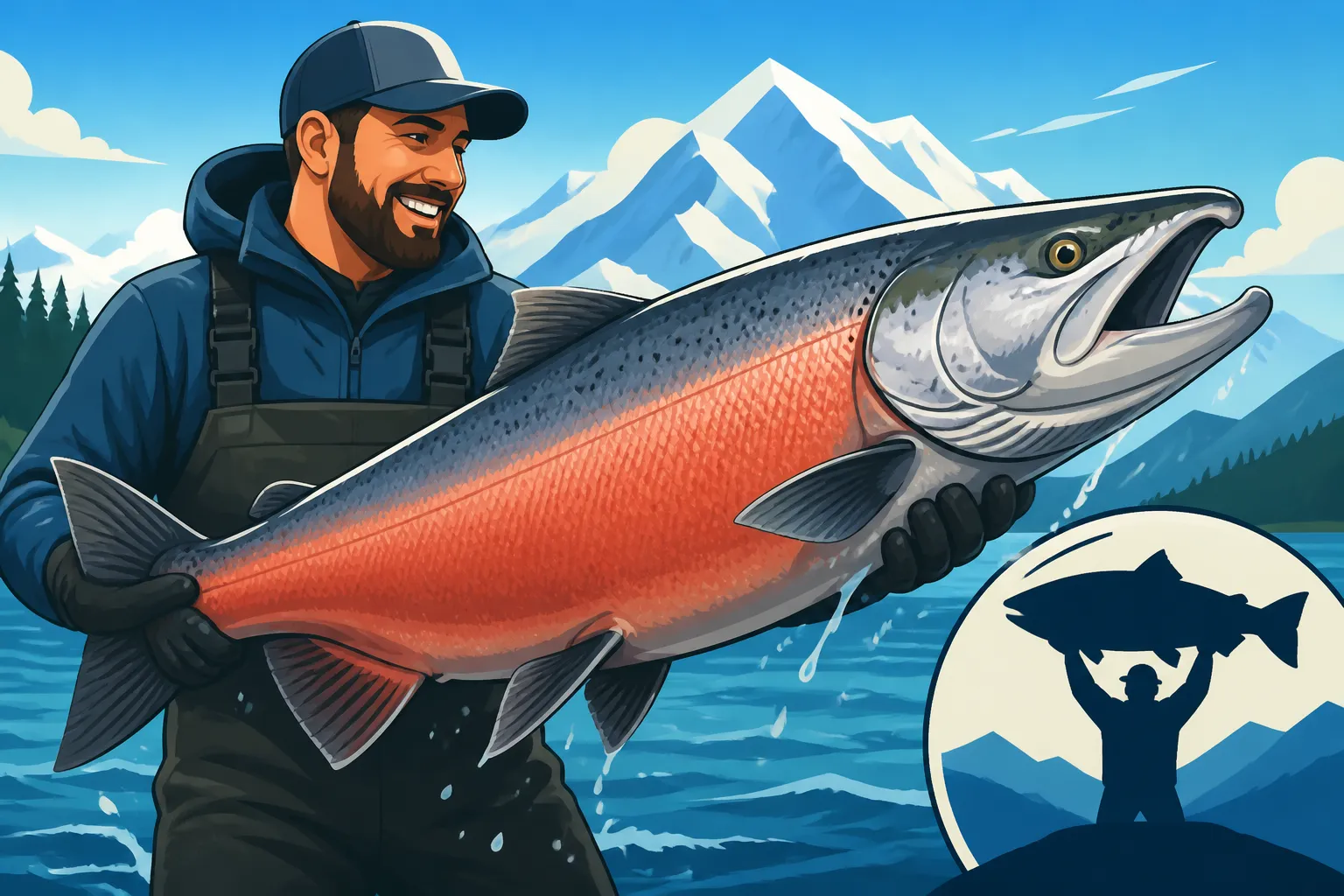
The undisputed champion, the King Salmon all-tackle world record, stands at an astonishing 97 pounds, 4 ounces. This colossal fish was caught by angler Les Anderson in 1985 on the Kenai River. Think about that for a second – almost 100 pounds of pure muscle and fighting power! This record has held for decades, a testament to the rarity and immense size of such a fish. It’s a benchmark that every serious King Salmon angler dreams of, a true leviathan of the freshwater world.
Imagine reeling in a fish that big; the fight must have been legendary. It serves as a reminder that while average sizes are one thing, the Kenai River truly holds the potential for once-in-a-lifetime encounters. When discussing records, it's crucial to distinguish between saltwater and freshwater catches, and different tackle categories, but for most, the Kenai River's 97-pounder is the record.
State Records and How They Differ
Beyond the all-tackle world record, individual states and organizations often maintain their own records, sometimes differentiating between freshwater and saltwater catches, or even specific gear types. For Alaska, the state record for a sport-caught King Salmon aligns with the all-tackle world record, given its immense size and the location of its capture on the Kenai River. However, if you were fishing in a different state, like Washington or Oregon, their state records for King Salmon would be considerably smaller, reflecting the different populations and growth rates in those waters.
These state records highlight regional variances and celebrate significant catches within local contexts. It’s a great way to recognize extraordinary fish caught in different environments, acknowledging that not every fishery can produce a 97-pound monster. Anglers are always on the lookout, hoping to best a local record, which is often a more achievable goal than topping the world record. If you ever think you've caught a record-breaker, understanding the specific rules for your region or the organization you’re submitting to, like the International Game Fish Association (IGFA), is critical.
The Hunt for a Personal Best
For most of us, chasing the all-tackle world record is a fun fantasy, but the real magic lies in improving our own personal best. That could mean landing your first King over 20 pounds, or finally breaking the 40-pound mark that you've been dreaming of. Every angler has that internal goal, that number in their head that signifies a truly epic catch. The satisfaction of besting your own record, whether it's by a pound or twenty, is an incredibly rewarding experience.
This journey of personal improvement is often what keeps us coming back to Alaska year after year. It’s about honing your skills, understanding the fish better, and enjoying the process. Sometimes, the fish that pushes your personal best isn't even the biggest fish on the boat, but it's your biggest fish, and that's what truly matters. Whether you're drift fishing with a guide or trying your hand at How to Bank Fish for Alaska Salmon, every cast holds the promise of that next personal best.
Measuring Your Alaskan King Salmon
So you've hooked into a true monster and brought it to the boat or shore. Now what? Knowing how to properly measure your fish is important, whether you're hoping to submit it for a record, just want accurate bragging rights, or need to adhere to specific regulations, especially if you're participating in a derby.
Proper Measurement Techniques
Accurate measurement is crucial. When measuring a fish for length, you typically want to measure from the tip of the snout (with the mouth closed) to the tip of the tail, with the tail pinched to achieve the maximum length. For girth, measure around the thickest part of the fish's body. These two measurements, along with its weight, provide the most complete picture of your catch. Many anglers carry a flexible tape measure or a dedicated fish ruler. You can find robust, waterproof tape measures on platforms like Amazon that are perfect for this kind of rigorous use in the Alaskan elements.
A quick tip: lay the fish flat on its side on a clean, wet surface if possible, or use a fish mat. This minimizes stress on the fish if you plan to release it. Make sure your measurements are taken quickly and carefully. For potential record submissions, consult the specific guidelines of organizations like IGFA, as they often have very precise rules for measurement and verification.
Documenting Your Catch for Records or Bragging Rights
Beyond just the numbers, documenting your catch is part of the experience. High-quality photos from multiple angles are essential. Try to get a clear shot of the fish next to a measuring device to substantiate its length. For weight, a certified scale is usually required for official records, but for personal use, a good quality digital fish scale will do the trick. Ensure the scale is calibrated and that you zero it out with any sling or bag you might use to weigh the fish.
Don’t forget the classic "grip and grin" shot with you and your trophy, but always prioritize the fish's health, especially if you intend to release it. Hold the fish horizontally, supporting its belly, and minimize its time out of water. This detailed documentation isn't just for bragging; it helps in understanding fish populations, growth rates, and contributes to a collective knowledge base of these incredible creatures. You'll also want to make sure you've recorded your catch if it's a King Salmon, as per the Alaska Harvest Record Card Explained.
Releasing Giants: Catch-and-Release Best Practices
Sometimes, especially with larger King Salmon, you might decide to release them, either because of regulations, personal choice, or if you’ve already filled your bag limit. Practicing proper catch-and-release is vital for the sustainability of these fisheries. Minimize the fight time to avoid over-stressing the fish. Keep the fish in the water as much as possible, using a knotless net if needed. Remove the hook gently with pliers or a dehooking tool. If the hook is deeply set, cutting the line as close to the hook as possible is often better than tearing at the fish's internal organs.
When taking photos, support the fish horizontally with both hands, never vertically by the jaw or tail, which can damage its spine and internal organs. Gently revive the fish by holding it upright in the current, allowing water to flow over its gills until it swims away under its own power. These practices, outlined in detail in guides like Alaska Catch-and-Release Best Practices, ensure that these magnificent Kings can continue their journey to spawn and contribute to future generations.
Beyond Just Size: The King Salmon Experience
While the size of an Alaska King Salmon is often the main talking point, the entire experience of fishing for them is what truly captures the hearts of anglers. It’s more than just a number on a scale; it’s about the adventure, the challenge, and the connection to the wild.
The Thrill of the Fight
Catching a King Salmon is an experience unlike any other. These fish are renowned for their incredible power, stamina, and stubborn refusal to give up. When a big King hits your line, it's not just a tug; it's an explosion of energy. They make powerful, sustained runs, peeling line off your reel with a screaming drag. They might head for snags, jump spectacularly, or simply bulldog their way to the bottom, testing every piece of your gear and every fiber of your being.
The fight can be long and grueling, lasting anywhere from 10 minutes to well over an hour for a true giant. It's a dance between angler and fish, a test of wills that leaves you breathless, with burning arms and an adrenaline rush that few other fishing experiences can match. This raw, visceral battle is what hooks so many people on Alaska fishing and explains why anglers spend so much time researching How to Catch King Salmon in Alaska and perfecting their techniques.
The Importance of Conservation
With the allure of big King Salmon comes the responsibility of conservation. Many King Salmon runs across Alaska have faced challenges in recent years, leading to stricter regulations, reduced bag limits, and even closures in some areas, like the Kenai River’s King Salmon fishery, to protect dwindling populations. This makes every fish, especially the larger, spawning adults, incredibly valuable to the future of the species.
Understanding and respecting these regulations, such as those found in Alaska King Salmon Fishing Regulations and Limits or Alaska Nonresident King Salmon Annual Limit Explained, is paramount. Choosing to practice catch-and-release, especially for large, healthy spawning fish, contributes directly to conservation efforts. Supporting sustainable fishing practices, ethical guides, and organizations dedicated to salmon habitat protection ensures that future generations can also experience the thrill of chasing these magnificent fish.
Preparing Your Catch
Once you’ve successfully landed and kept your King Salmon, the next exciting step is preparing your catch. King Salmon are highly prized for their rich, succulent, and flavorful meat. Whether you plan to grill it, smoke it, or freeze it for later, proper handling is key to preserving its quality. Most charters and guides offer fish processing services, or they can direct you to local processors who will professionally fillet, vacuum seal, and freeze your fish, often even arranging shipping back home. Companies like Coal Point Seafood Co. in Homer, for example, are experts in this.
If you’re processing it yourself, learning How to Fillet a Salmon in Alaska properly will ensure you get the most meat from your fish. Many anglers invest in quality fillet knives and vacuum sealers, which you can often find great options for on Amazon, to prepare their catch for the journey home. Enjoying a meal of fresh Alaskan King Salmon is the perfect culmination of an incredible fishing adventure, a delicious memory of your time in the wilderness.
Conclusion
Chasing King Salmon in Alaska is an incredible journey, and while the thought of a world record fish is exhilarating, it's the entire experience – from the vast landscapes to the powerful fight – that truly makes it unforgettable. Understanding the realistic sizes you're likely to encounter, appreciating the factors that influence their growth, and knowing how to properly handle and document your catch will only enhance your adventure. Remember, every King Salmon caught in Alaska is a trophy in its own right, a testament to the wild spirit of this amazing state.
Disclaimer
The information provided in this guide is for general informational purposes only and is subject to change. Fishing regulations in Alaska can be complex and are often updated. Always consult the most current Alaska Department of Fish and Game regulations and any emergency orders before heading out on your fishing trip. The author and publisher are not responsible for any actions taken based on the information presented herein.