How to Identify a Coho Salmon
There’s nothing quite like the thrill of feeling that tug on your line in an Alaskan river, but for many anglers, especially those just starting out, the excitement can quickly turn into a head-scratching moment: "What is this fish?" Misidentifying a Coho salmon, also affectionately known as a silver salmon, is a common snag that can lead to confusion about regulations, bag limits, and even the best way to handle your catch. This comprehensive guide is here to untangle that mystery, giving you all the crucial signs to confidently identify a Coho salmon, ensuring your Alaska fishing adventures are both compliant and incredibly rewarding.
Why Accurate Coho Identification is Crucial
Angling in Alaska is an experience like no other, but it comes with a serious responsibility: knowing your fish. Trust me, I've seen countless folks stare at their catch, genuinely unsure if it's the beautiful Coho they were hoping for or another salmon species. This isn't just about bragging rights; it’s about respecting the fisheries and adhering to the rules. Alaska’s fishing regulations are incredibly specific, often dictating different bag limits, seasons, and even legal gear requirements for each salmon species. Getting it wrong can quickly turn a fantastic day on the water into a costly lesson in fines.
Adhering to Bag Limits and Seasons
Imagine you're out on the Kenai Peninsula, having a banner day, and you're keeping track of your daily limit. If you accidentally count a rogue Sockeye as a Coho, or vice versa, you could easily exceed the legal limit for one species without even realizing it. The Alaska Department of Fish and Game (ADF&G) sets these limits based on conservation efforts, ensuring sustainable populations for everyone. Each species has its own unique run timing and abundance, which directly impacts the regulations. For instance, the limits for Coho salmon can be vastly different from those for King salmon, especially when you consider potential emergency orders that might shut down one fishery while another remains open. Knowing your target fish helps you avoid these pitfalls and ensures you're a responsible steward of Alaska's incredible resources. You can dive deeper into the specifics by checking out the Alaska Fishing Regulations Explained.
Ensuring Proper Catch and Release Practices
Even if you're practicing catch and release, accurate identification still plays a critical role. Different fish species have varying levels of resilience and specific handling requirements. For example, some species might be more delicate and require swift, careful release to maximize their survival rate, especially if they are wild or protected stocks. When you can correctly identify a Coho, you're better equipped to handle it in a way that minimizes stress and injury, whether that means keeping it wet, using the right de-hooking tool, or understanding if it's a hatchery fish versus a wild one that might need extra care. Proper handling is key to maintaining the health of the fishery, and it’s a practice every ethical angler should embrace.
Distinctive Physical Traits of a Coho Salmon
So, how do you pick a Coho out of a lineup? When they first enter freshwater, Cohos are often the picture of sleek, silver beauty, which is why they earned their "silver salmon" nickname. But a closer look reveals some key features that set them apart from their cousins. You'll want to pay close attention to their mouth, tail, and spotting patterns. These details are often the most reliable identifiers, especially when comparing them side-by-side with other species.
Mouth and Gumline Characteristics
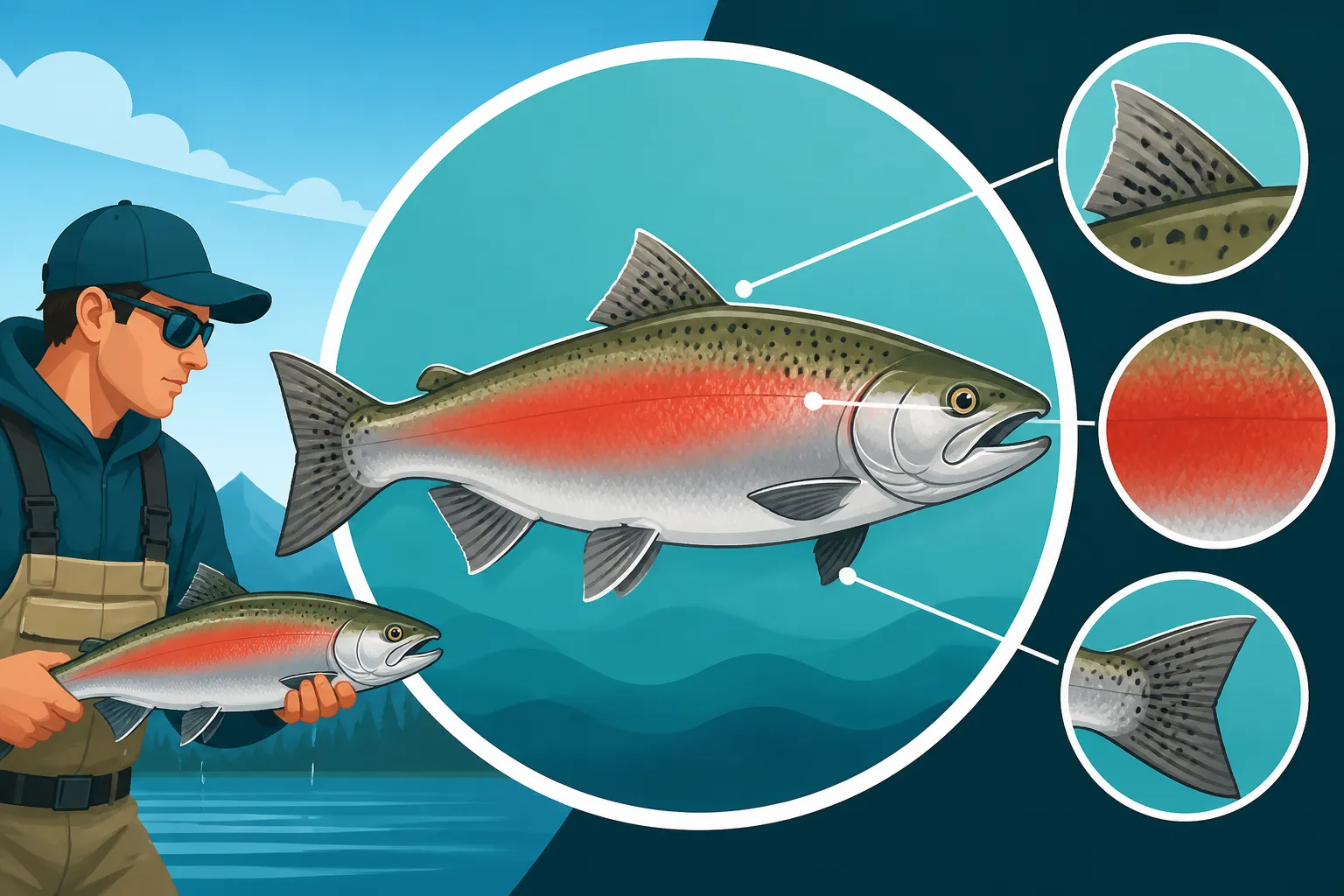
One of the absolute best ways to identify a Coho is to gently lift its gill plate and examine its mouth and gum line. Coho salmon typically have a white gum line along their lower jaw, and it remains white at the base of the teeth, without any black pigmentation on the gums themselves. This is a critical distinction from King salmon (Chinook), which will have a black gum line that extends all the way to the base of the teeth.
Another tip-off is the color of their mouth lining. While King salmon usually have a dark or black mouth lining, Coho salmon often have a dark mouth lining with a distinctive white or very pale gum line. It’s a subtle but consistent trait. Look closely at the tongue and the roof of the mouth – if the gums where the teeth are rooted are white, you’re almost certainly looking at a Coho. It might take a bit of practice, but once you know what to look for, this particular feature becomes incredibly reliable.
Tail and Spotting Patterns
The tail, or caudal fin, is another major clue for Coho salmon. They generally have a slightly forked tail, not as deeply forked as a Sockeye (Red) salmon, but definitely more so than the square-cut tail of a Pink (Humpy) salmon. What's truly distinctive about a Coho's tail is the spotting pattern. You'll typically find spots on the upper lobe of the caudal fin, but they will be sparse or absent on the lower lobe. This is a stark contrast to King salmon, which have spots scattered throughout both the upper and lower lobes of their tail.
Beyond the tail, Coho salmon usually have small, irregular spots on their back, extending to the upper part of their body above the lateral line. These spots are usually rounder and less pronounced than the larger, more defined spots you'd find on a King salmon. When a Coho is fresh from the ocean, these spots can be subtle against their brilliant silver scales, but as they spend more time in freshwater, their coloration deepens, and the spots often become more apparent. A good pair of polarized sunglasses, available on Amazon, can help you spot these details even before you bring the fish close.
Body Shape and Coloration
When Coho salmon first enter the rivers from the ocean, they are stunningly chrome-bright, almost mirror-like, giving them that famous "silver" moniker. Their body shape is generally streamlined and somewhat compressed side-to-side, giving them a sleek appearance that’s built for speed. As they transition into freshwater and begin their spawning migration, their coloration undergoes a dramatic change.
They start to develop a darker, reddish-maroon hue along their sides, especially in males, and their backs turn a greenish-black. The belly might retain some silver or turn a dull white. This transformation is part of their natural life cycle, and it can make identification a little trickier for the untrained eye. However, even with the color change, those key mouth and tail characteristics generally remain consistent. Males, particularly, will develop a more pronounced kype (a hooked jaw) as they approach spawning, which is a common trait among mature salmon species preparing to reproduce.
Comparing Coho with Other Popular Alaska Salmon
Alaska is home to all five species of Pacific salmon, and while they all share a family resemblance, each has its unique characteristics. Often, the easiest way to identify a Coho is by understanding how it differs from the species you’re most likely to encounter in the same waters. Knowing these distinctions can save you a lot of guesswork. For a broader understanding of the family, check out our guide on Types of Salmon in Alaska Explained.
Coho vs. King Salmon (Chinook)
This is probably the most common identification challenge. Both are large, powerful fish, and fresh-run Kings can also be quite silver. The definitive difference, as mentioned, is the mouth. A King salmon (Chinook) will have a black gum line that extends all the way down to the base of its teeth, both upper and lower. Its entire mouth is typically dark or black. A Coho, on the other hand, will have a white gum line on its lower jaw, even though its mouth might be dark inside.
Furthermore, King salmon usually have large, irregular black spots on both lobes of their tail fin, and often have more spots along their back and dorsal fin than a Coho. Their body shape is generally more robust and thicker than a Coho's. King salmon are often much larger, with adults averaging 20-30 pounds, while Cohos typically range from 8-15 pounds. For a deeper dive, read about the King vs Sockeye Salmon Differences, which also helps contextualize King characteristics.
Coho vs. Sockeye Salmon (Red)
Sockeye salmon are generally easier to distinguish, especially during their spawning phase. Fresh-run Sockeye are exceptionally silver with a bluish-green back, but they lack the prominent spots of a Coho. Their most telling feature when mature is their vibrant red body and green head, which they develop as they enter freshwater. Their tail is also typically more deeply forked than a Coho's.
Inside the mouth, Sockeye have entirely white or very pale mouths and gums, with tiny, almost imperceptible teeth. This is a clear contrast to the darker mouth interior and white gum line of a Coho. Size-wise, Sockeye are usually smaller than Cohos, often weighing between 4-8 pounds. If you’re fishing a river teeming with red-bodied fish, you’re almost certainly among Sockeye. To further differentiate, consider reading Sockeye vs Coho Salmon Differences.
Coho vs. Pink Salmon (Humpy)
Pink salmon, or "humpies," are usually the easiest to tell apart due to their unique features. The most obvious characteristic of a mature male Pink salmon is the distinct, humped back they develop during spawning, giving them their nickname. They are also the smallest of the Pacific salmon, typically weighing only 3-5 pounds.
Pink salmon have very large, oval-shaped spots on their back and entire tail fin, much larger and more numerous than a Coho's. Their scales are very small, giving them a finer texture. Their mouth is also completely white inside, without the dark mouth or white gum line characteristics of a Coho. The sheer abundance of Pinks in certain years, especially in odd-numbered years, makes them a common catch, so knowing how to tell them from the more prized Cohos is very useful. More details on the differences can be found in Pink vs Chum Salmon Differences.
Habitat and Behavioral Clues
Beyond their physical appearance, where and how a fish behaves can give you significant clues about its species. Coho salmon have distinct preferences for certain types of water and exhibit specific behaviors that can help you identify them before they even hit your net. Understanding these patterns can improve your chances of targeting Coho effectively and confirming your catch.
Preferred Waters and Migration Patterns
Coho salmon prefer clear, cool freshwater streams and rivers for spawning, often choosing tributaries with moderate flows and plenty of cover from overhanging vegetation or woody debris. They are known for their strong jumping ability, often leaping over obstacles in rivers during their upstream migration. You'll find them widely distributed throughout coastal Alaska, from Southeast to the Gulf of Alaska, and up into areas like Cook Inlet and Prince William Sound. Iconic rivers like the Kenai River and its tributaries, as well as many streams in the Mat-Su Valley, are prime Coho territory.
Their migration typically occurs later in the summer and into the fall compared to other salmon species. While King salmon runs peak in early summer and Sockeye in mid-summer, Coho generally start showing up in good numbers from mid-August through September, and sometimes even into October in certain systems. This later timing is why they are often called "fall salmon." Knowing When Do Silver Salmon Run in Alaska can be a huge advantage. They tend to hold in deeper pools and runs, often near structure, before moving onto their spawning grounds.
Aggressive Feeding Behavior
One of the most enjoyable aspects of fishing for Coho salmon is their aggressive nature. Unlike Sockeye, which are primarily plankton feeders and notoriously difficult to entice with traditional baits or lures once they enter freshwater, Coho retain a strong predatory instinct. They actively strike at baits, lures, and flies, making them a fantastic sport fish. They’re opportunistic feeders, and their willingness to chase down a flashy spinner or a drifting cured egg imitation is a tell-tale sign of a Coho bite.
This aggressive behavior means you often feel a more distinct, hard strike when a Coho takes your offering. They fight hard, often making acrobatic jumps and powerful runs, which adds to their appeal. If you're consistently getting strong, confidence-inspiring bites on hardware or bait, and the fight is energetic and aerial, you're likely dealing with a Coho. This contrasts with the more subtle "flossing" technique often used for Sockeye or the deep, powerful head-shakes of a King. For tips on what they bite, check out Best Lures and Bait for Alaska Coho Salmon.
Practical Tips for On-the-Water Identification
When you're out on the river, things move fast. Fish are landed, pictures are taken, and sometimes, decisions need to be made quickly regarding retention or release. Having a few quick checks in your mental toolkit can make all the difference. Always remember that a fish’s appearance can vary based on its time in freshwater, its age, and even local water conditions.
What to Look for First
When you land a salmon in Alaska, take a deep breath and quickly scan for these key identifiers:
- Tail Spots: Are there spots predominantly on the upper lobe, with few or none on the lower? If so, lean towards Coho. If spots are on both lobes, consider a King. If no spots at all, think Sockeye or Chum.
- Gum Line: Gently lift the gill plate and peek inside the lower jaw. Is the gum line white at the base of the teeth, even if the rest of the mouth is dark? This is a strong indicator of a Coho. If it’s entirely black, it’s a King. If entirely white or pale with tiny teeth, it’s a Sockeye or Pink.
- Body Shape/Color: Is it streamlined and relatively thin compared to its length? Is it chrome silver if fresh, or developing a maroonish hue if it's been in the river for a while? If it’s extremely humped or brilliant red, you’re looking at Pinks or Sockeye, respectively.
Having a waterproof identification card or a reference photo on your phone can be incredibly helpful, especially when you’re still learning. Many outdoor stores in Alaska, or even online retailers like Amazon, sell compact, laminated fish identification guides that you can clip to your vest or tackle box.
Tools and Resources for Identification
Beyond your keen eye, a few simple tools can assist in accurate identification. A small pair of forceps or pliers can help you gently open a fish's mouth for a quick gum line check without causing harm, especially if you plan to release it. A measuring tape can also be useful to confirm length, as different species often have distinct average sizes. For example, if you catch a salmon that feels huge, say over 20 pounds, and it has a black gum line and spots on both tail lobes, it's almost certainly a King, not a Coho.
Familiarize yourself with the ADF&G's sport fishing regulations booklet for the specific region you're fishing. These booklets are treasure troves of information, complete with illustrations and detailed descriptions of each species. They are readily available at most tackle shops, charter offices, and online. Always carry a copy, either physical or digital, and know how to check Alaska Fishing Emergency Orders Explained as rules can change quickly.
Comparison Table: Coho vs. Common Alaska Salmon Species
Here's a quick reference table to help you keep the main differences straight:
| Feature | Coho Salmon (Silver) | King Salmon (Chinook) | Sockeye Salmon (Red) | Pink Salmon (Humpy) | Chum Salmon (Dog) |
|---|---|---|---|---|---|
| Gum Line | White on lower jaw, dark mouth | Black, entire mouth usually dark | All white/pale, small teeth | All white/pale, small teeth | All white/pale, strong teeth |
| Tail Spots | Sparse/none on lower lobe, some on upper | Present on both upper & lower lobes | No spots | Large, oval spots on entire tail | No spots |
| Body Spots | Small, irregular above lateral line | Large, irregular all over body | None | Large, oval spots on back | None, but vertical bars on spawning fish |
| Body Shape | Sleek, streamlined, compressed | Robust, thick, deep-bodied | Streamlined, less compressed | Smallest, pronounced hump (males) | Stout, blocky |
| Average Size | 8-15 lbs | 20-30 lbs (can be much larger) | 4-8 lbs | 3-5 lbs | 8-18 lbs |
| Spawning Color | Reddish-maroon, dark back | Dark olive to maroon, dark head | Vibrant red body, green head | Olive green/brown, dark humped back | Blotchy green/purple/red vertical bars |
Remember, practice makes perfect. The more fish you encounter and carefully examine, the more intuitive Coho identification will become. Soon, you'll be confidently calling out "Coho!" with the best of them, making your Alaska fishing adventures even more enjoyable and respectful of the incredible natural resources we're so lucky to experience. And don't forget to look into Alaska Coho Salmon: Size, Season, and Where to Catch for more specific details about these magnificent fish!
Disclaimer
The information provided in this guide is for general informational purposes only and is not intended as legal advice regarding fishing regulations. Alaska's fishing regulations can change frequently, sometimes even in-season, due to emergency orders. It is the responsibility of every angler to consult the most current Alaska Department of Fish and Game (ADF&G) regulations booklet for the specific region and time they are fishing before heading out. Always adhere to all local, state, and federal laws and regulations.