How to Fish Alaska Tides for Halibut
There is nothing quite as humbling as watching a four-pound lead weight get swept sideways like a leaf in a storm while saltwater fishing in Southcentral Alaska. If you have ever felt the deep frustration of your line scoping out at a ridiculous 45-degree angle without ever finding bottom, you are certainly not alone. Mastering how to read, time, and fish Alaska tides for halibut is the single most critical skill that separates an empty cooler from a freezer packed with thick, sweet fillets.
Understanding Alaska Extreme Tides and Halibut Behavior
To catch Pacific halibut consistently in the Last Frontier, you first have to respect the sheer volume of water moving across the seafloor every six hours. Regions like Cook Inlet, Resurrection Bay, and Kachemak Bay experience some of the most dramatic tidal swings on the planet. When millions of gallons of ocean rush through narrow fjords and over deep trenches, the underwater environment transforms into a raging river. Understanding how flatfish react to this movement is the key to planning a successful outing.
Why Alaska Tides Are So Powerful
The geographical funneling effect of Alaska’s coastal topography creates massive tidal exchanges. In areas highlighted in our Cook Inlet Fishing: What to Know Before You Go guide, water levels can rise or fall by more than twenty vertical feet in a single cycle. This mass movement of water creates intense underwater currents that make holding a bait stationary near the bottom nearly impossible during the peak of the tide cycle.
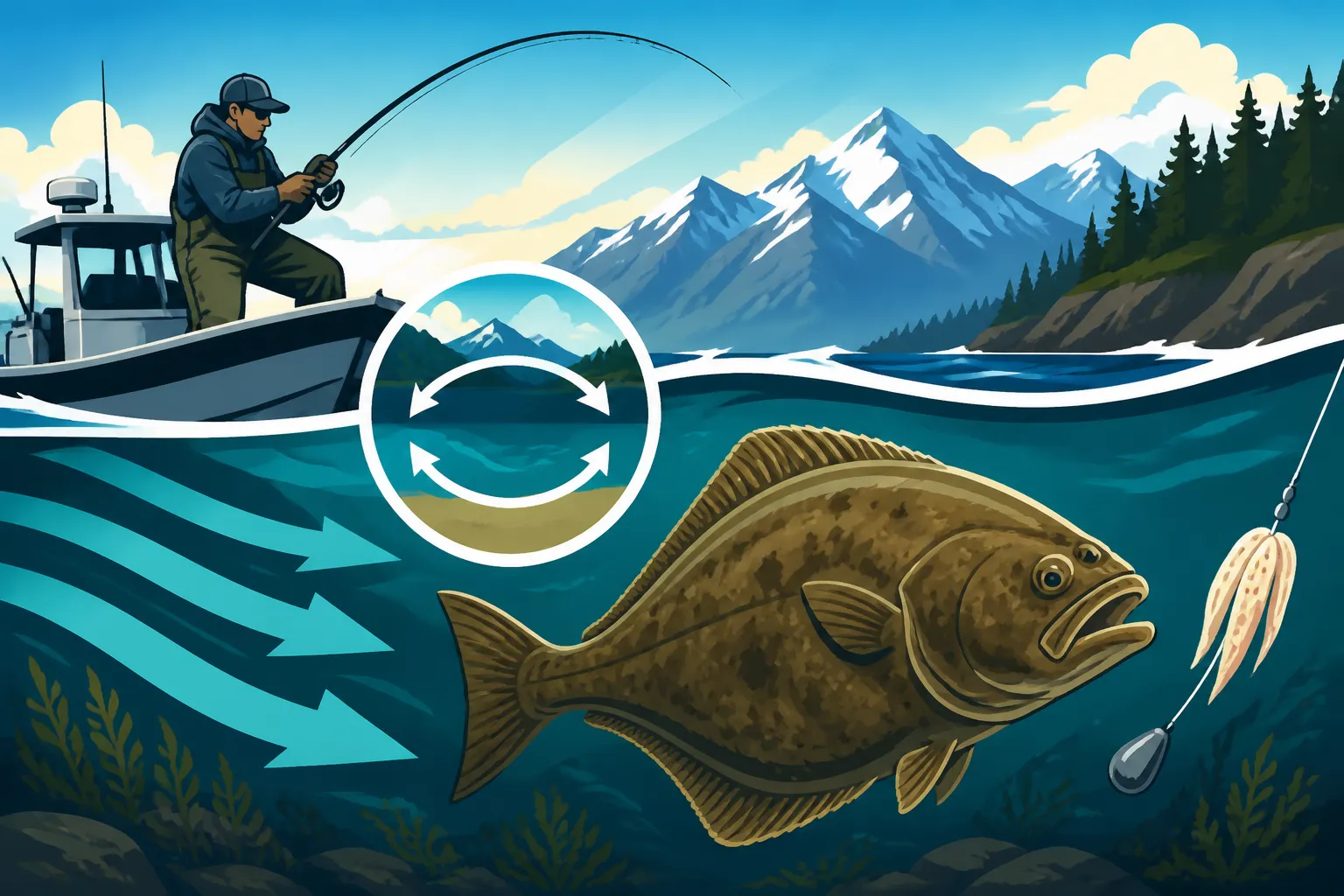
For the angler, this movement creates immense water resistance on your fishing line. As the current picks up speed, it catches your line and bows it out, lifting your heavy sinker off the seabed. If your bait is suspended ten feet off the bottom because of current drag, you are effectively fishing in a dead zone, as bottom-dwelling flatfish rarely charge up into heavy water column currents to chase a meal.
How Halibut Feed During Tidal Shifts
Halibut are opportunistic, scent-driven bottom predators. Their broad, flat bodies are engineered to lie flush against gravel bars, mud flats, and rocky contours, letting the current wash over them. During heavy water movement, halibut prefer to hunker down behind underwater structures, ledges, and drop-offs to conserve energy. They let the rushing tide do the work of tumbling crabs, octopus, and smaller baitfish across the floor.
As the tide begins to slow down approaching “slack water,” halibut become far more active. The reduced current allows them to glide easily across the seabed to hunt. More importantly, a gentler current allows the scent of your bait to travel out in a concentrated, steady plume along the sea floor rather than being instantly diluted and swept away by violent currents.
The Danger of Heavy Water and Blowouts
Attempting to fish during the peak flow of a major tidal exchange is known locally as dealing with “heavy water” or a “blowout tide.” During these two-to-three-hour windows, the velocity of the ocean current makes bottom contact virtually impossible without using absurd amounts of weight that wear out your arms and tackle.
When currents rip too fast, your lead weight will bounce along the bottom, snagging on boulders or burying itself in deep crevices. Snagging in 150 feet of water with five-knot currents running overhead usually results in broken lines, lost terminal tackle, and sore shoulders. Recognizing when the water is simply moving too fast allows you to save your strength, refresh your baits, and prepare for the prime feeding window.
Timing the Tide: Finding the Golden Slack Water Window
The secret to productive halibut fishing lies in calculating and targeting “slack water.” Slack water is the brief window when the tide reaches its highest or lowest point and pauses before reversing direction. During this period, current velocity drops to near zero, giving you maximum control over your line and presentation.
High Slack vs. Low Slack Water
Both high slack (the peak of high tide) and low slack (the lowest point of low tide) offer exceptional fishing opportunities, but they behave slightly differently depending on your location. High slack generally brings clearer, cleaner oceanic water into bays and inlets, which can improve visibility in turbid zones. Low slack concentrates fish into deeper channels and holes as shallow flats drain out.
Generally, the prime fishing window opens roughly 45 minutes before peak slack water and stays open for about 45 minutes after the tide turns. This 90-minute window is when the vast majority of halibut are hooked on any given trip. Anglers launching out of ports featured in our Homer Halibut Fishing Guide build their entire day around these precise 90-minute windows.
Reading Alaska Tide Tables Correctly
To time your trip perfectly, you must learn to read a local marine tide chart. Ocean tides follow the “Rule of Twelfths,” which dictates how current speed builds and recedes over a six-hour period:
- 1st Hour: 1/12th of the total water volume moves (Current is building slowly)
- 2nd Hour: 2/12ths of the total water volume moves (Current speeds up)
- 3rd Hour: 3/12ths of the total water volume moves (Peak current speed / Heavy water)
- 4th Hour: 3/12ths of the total water volume moves (Peak current speed / Heavy water)
- 5th Hour: 2/12ths of the total water volume moves (Current begins slowing down)
- 6th Hour: 1/12th of the total water volume moves (Slack water approaches)
Notice that during the middle hours (hours 3 and 4), half of the entire tidal volume moves across the ocean floor. This is when fishing is toughest. Conversely, hours 1, 6, and the turns offer the most manageable conditions. Before heading out, anglers often jump on Amazon to pick up rugged, waterproof tide watches or digital boat mounts to track these precise curve shifts right from the skiff.
Adjusting Strategy for Neap vs. Spring Tides
Tidal ranges vary significantly based on the moon cycle. “Spring tides” occur during full and new moons, producing massive water swings, raging currents, and brief slack water windows. “Neap tides” occur during quarter moons, producing gentle water movement, minimal depth changes, and extended periods of fishable water.
If you are planning your vacation around specific dates, checking a calendar cross-referenced with our Best Time to Catch Halibut in Alaska guide will help you target neap tide series. During neap tides, you can often fish straight through the cycle using lighter sinkers, whereas spring tides require precise surgical timing to drop your lines right at the turn.
Tactical Rigging and Anchoring Strategies for Moving Water
Adapting your gear and boat positioning to match the current speed is crucial. Using the wrong line, oversized terminal tackle, or improper anchor setups will ruin your chances long before a halibut ever smells your bait.
Rigging for Heavy Current
Line diameter plays an immense role in how your gear handles moving water. Traditional heavy monofilament line acts like a thick sail in underwater currents, dragging your rig off the bottom. Modern braided fishing line, with its ultra-thin diameter and zero stretch, cuts through moving water with far less resistance.
Before loading your reels for an Alaska trip, browse Amazon for high-quality 60-to-80-pound test braided lines, as the thin profile allows you to hold bottom with significantly less lead weight. Pair your braided main line with a heavy-duty sliding weight sleeper rig or a commercial-grade steel spreader bar to keep your hooks from wrapping around the main line in swirl currents. Reviewing How to Set Up a Halibut Rig for Alaska will give you a clear breakdown of how to construct these durable setups.
Selecting the Right Lead Weight
Matching your weight to the current speed is a continuous balancing act. If your weight is too light, your bait skips off the seafloor; if it is unnecessarily heavy, you lose touch with subtle halibut bites and tire yourself out quickly.
| Tidal Stage | Average Current Speed | Recommended Sinker Weight | Primary Rigging Focus |
|---|---|---|---|
| Peak Slack Water | 0.0 – 0.5 Knots | 12 oz – 16 oz (1 lb) | Direct bottom drop, light presentation |
| Building / Slowing Tide | 0.6 – 1.5 Knots | 24 oz – 32 oz (1.5 – 2 lbs) | Controlled drift or steady anchor soak |
| Moderate Running Current | 1.6 – 2.5 Knots | 32 oz – 48 oz (2 – 3 lbs) | Heavy braid line, spreader bar stability |
| Peak Heavy Water | 2.6+ Knots | 48 oz – 64 oz+ (3 – 4+ lbs) | Re-baiting, gear checks, or moving spots |
As detailed in our breakdown of the Best Weight for Alaska Halibut Fishing, keeping a wide assortment of cannonball and torpedo sinkers in your boat box ensures you can adjust on the fly as water movement speeds up or slows down.
Anchor Placement and Scent Trail Management
Anchoring is widely considered the most effective way to hunt big halibut in moving water, provided you do it safely. When your vessel is pinned in place by an anchor, the natural current carries a steady scent trail down-current from your boat, acting as a underwater highway that leads directly to your hooks.
Position your boat up-current from prime structure, such as an underwater gravel mound or drop-off. Drop your anchor and let out enough rode so that your vessel rests directly over or slightly above the target zone. As you chop up salmon carcasses or herring to load your bait scent buckets, the tidal flow carries those juices hundreds of yards downstream. For detailed safety steps on anchoring in heavy current zones, review our guide on How to Anchor for Alaska Halibut.
Hook Selection and Bait Security
Because halibut bite gently in heavy water before committing, using the right hook is critical. Extra-large offset circle hooks are the absolute standard across Alaska’s saltwater fleet. Circle hooks are designed to slide to the corner of a flatfish’s jaw and roll cleanly into place as the fish turns and swims away with the tide.
Pair your hooks with durable baits like octopus, squid, or tough salmon heads that won’t easily wash off the hook in three-knot currents. Anglers often pick up box-packs of heavy circle hooks from Amazon alongside bait elastic thread to securely bind soft herring to their hooks. To optimize your terminal setup, check out our guides on Best Circle Hooks for Alaska Halibut and Best Bait for Alaska Halibut.
Step-by-Step Guide to Fishing Tidal Shifts Real-Time
To give yourself the absolute best chance of landing a fish of a lifetime, follow this step-by-step game plan as you navigate a live tidal shift on the water.
Phase 1: The Pre-Slack Setup (1 Hour Before Slack)
- Position the Boat: Arrive at your chosen reef, ledge, or channel ahead of time. Check your GPS plotters and tide apps to ensure your anchor will set properly up-current from the target structure.
- Prepare the Rigging: Tie on your heavy braid main line, attaching a spreader bar or slider sleeve. Select a weight that feels slightly heavy for the current conditions—typically 24 to 32 ounces as the tide slows.
- Bait Up Heavy: Load your circle hooks with a combination of durable octopus or salmon skin paired with a oily piece of fresh herring. The tough bait stays on the hook while the oily bait creates an aggressive initial scent trail.
- Deploy Scent: If using a bottom-weighted scent pot or chum box, lower it to the bottom first so it begins establishing a line of scent as the current tempers down.
Phase 2: The Golden Window (Slack Water)
- Drop to the Seabed: Lower your weight controlled and smoothly to avoid tangling your leader in the water column. Touch bottom, then crank your reel up 1 to 2 turns so your weight hovers just inches off the rocks.
- Lighten Your Weight: As the water pauses entirely at peak slack, swap out your 2-pound cannonballs for lighter 12-to-16-ounce weights. Lighter sinkers allow you to feel delicate taps and nibbles that heavy lead masks.
- Maintain Contact: Keep your rod tip steady. Lift the rod tip occasionally to feel for the bottom, making sure you aren’t drifting away from the seabed as depth changes slightly.
- Let the Circle Hook Work: When you feel a rhythmic tap-tap-tap of a feeding flatfish, do not set the hook violently. Instead, lower your rod tip, let the rod load up completely as the fish turns, and reel smoothly and steadily until the hook sets itself firmly in the jaw.
Phase 3: The Post-Slack Turn (1 Hour After Slack)
- Increase Lead Weight: As the new tide begins to push and gather speed in the opposite direction, immediately step up your weight back to 32 or 48 ounces to maintain a vertical line angle.
- Scope Management: If your line begins scoping out beyond a 30-degree angle, free-spool your reel carefully until you re-establish bottom contact, then lock the drag back down.
- Process Your Catch: Once your limits are secured under current state guidelines, bleed your fish immediately in a deck wash ice bath. Staying clear on regulations like the Alaska Halibut Limit for Unguided Anglers ensures you stay compliant while harvesting fresh wild seafood.
- Clean and Store: Before heading back to port, stock up on heavy vacuum seal bags on Amazon so you are completely prepared to turn your prize catch into perfectly packaged frozen steaks using advice from our walkthrough on How to Fillet a Halibut.
By respecting the incredible power of Alaska’s oceans, timing your drops to the minute, and adapting your tackle to the moving current, you turn unpredictable tidal waters into your greatest asset on the fishing grounds.
Disclaimer
This article is for general informational purposes only and does not constitute professional advice. Laws, prices and regulations vary by location and change over time. Consult a qualified professional for guidance on your specific situation.