How to Identify a Chum Salmon
One of the most common frustrations for anglers, especially those new to Alaska's incredible fisheries, is confidently telling one salmon species from another. With so many different runs and varying appearances depending on their stage in life, it's easy to mistake a lively chum for a coho, or wonder if that fish on your line is truly what you think it is. This comprehensive guide will equip you with all the knowledge you need to identify a chum salmon, often called a dog salmon, with certainty, ensuring you're always within regulations and maximizing your fishing experience.
Why Chum Salmon are Often Misunderstood and How to Spot Them
Chum salmon, or Oncorhynchus keta, often get a bit of a bad rap, sometimes being overlooked in favor of their more famously delicious cousins like sockeye or king salmon. This undeserved reputation can lead to anglers not paying close enough attention to their unique features, making identification harder than it needs to be. Understanding their life cycle and the changes they undergo is key to accurate identification.
Their Reputation and Why It's Unfair
It's true that chum salmon, especially once they've been in fresh water for a while, develop a somewhat softer, paler flesh compared to a chrome-bright sockeye or king. This has led to the "dog salmon" moniker, implying they're only fit for dog food or subsistence use in some circles. However, this is a huge disservice to these powerful fish. When caught fresh from saltwater or near the river mouths, a bright chum salmon is a formidable fighter and excellent table fare, often used for smoking or canning. Many seasoned Alaskan anglers appreciate the intense fight a fresh chum provides, especially on lighter tackle. They're also incredibly important to the ecosystem, providing food for bears, eagles, and other wildlife. For more on their characteristics, you might want to read our full guide on Alaska Chum Salmon: Facts and Fishing Tips.
The Challenge of Changing Appearances
One of the biggest hurdles in identifying any salmon species, chums included, is their dramatic transformation as they transition from the ocean to their spawning grounds. A chum salmon fresh out of the Bering Sea or Gulf of Alaska will look vastly different from one that has spent a few weeks battling its way up the Yukon River. In the ocean, they are sleek, silver torpedoes. As they near their natal streams, they develop vibrant colors, pronounced teeth, and the distinctive 'tiger stripes' that make them easier to identify. This shift means you can't rely on just one set of characteristics; you need to understand the full spectrum of their appearance.
Key Physical Characteristics of a Chum Salmon
When you've got a fish on the line, or one flopping on the bank, knowing what to look for can make all the difference. Chum salmon have several distinct physical traits that set them apart from other species.
Mouth and Teeth: The "Dog Salmon" Name
This is often the most telling feature, particularly for male chum salmon as they get closer to spawning. The name "dog salmon" isn't just a casual jab; it's a direct reference to their impressive, canine-like teeth.
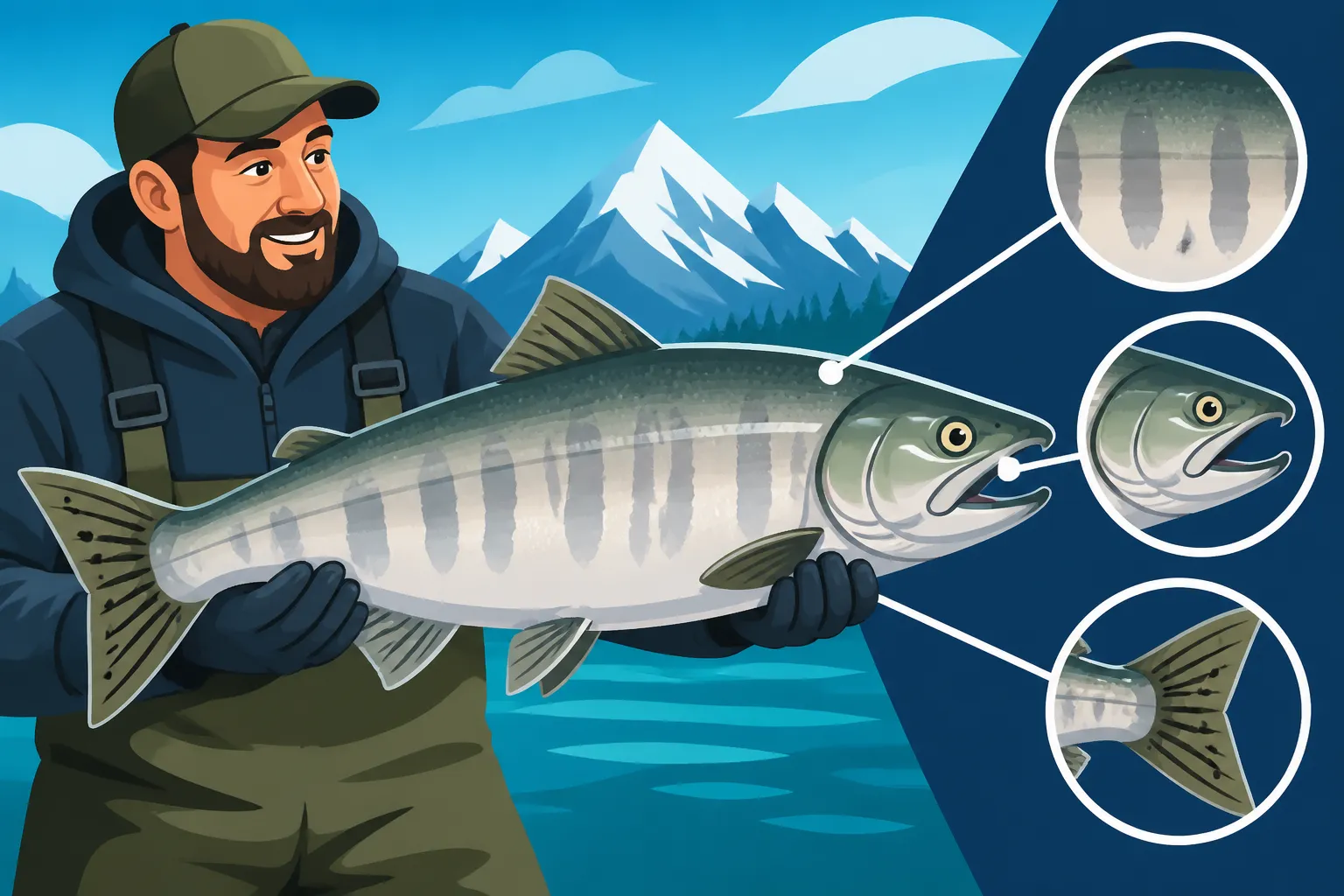
- Male Spawners: Male chums develop extremely prominent, large, recurved teeth that protrude from their jaws, giving them a truly fearsome appearance. Their jaws also become elongated and hooked, forming a kype similar to but often more exaggerated than other salmon. These teeth are not for feeding but for fighting rival males and defending spawning territory.
- Female Spawners and Ocean-Phase Fish: While not as dramatic as the males, female chums and all chums in their ocean phase still have noticeably larger and more developed teeth than sockeye or pink salmon, though less so than king or coho. If you gently open the mouth, you'll see a distinct set of teeth, not just a gum line. This feature is a strong indicator of a chum, especially when you're examining a bright, chrome fish where other features might be less pronounced.
Coloration: From Silver to "Tiger Stripe"
The color changes of a chum salmon are perhaps their most striking and memorable identification marker.
- Ocean Phase (Bright Silver): In the saltwater, chum salmon are typically a brilliant, metallic silver along their sides, fading to a darker greenish-blue on their backs and a white belly. They are very sleek and lack significant spots, distinguishing them from kings or cohos that often have spotting on their backs or tail fins. At this stage, they can sometimes be confused with silvers (coho) due to their streamlined shape and silver sheen, but the lack of spots and specific fin shapes (which we'll cover soon) help differentiate them.
- Spawning Phase (Tiger Stripes): This is where the chum truly earns its unique look. As they enter freshwater and move towards their spawning beds, their bodies transform. They develop bold, vertical bars or "tiger stripes" of dark green, purple, or maroon against a lighter, often yellowish or olive-green background. These stripes are particularly vibrant on males. Their bellies may turn a creamy white or light yellow. This "calico" or "tiger stripe" pattern is unmistakable and is one of the easiest ways to identify a mature chum salmon. You can often see these patterns clearly on fish holding in river pools, preparing to spawn. Learning to recognize these patterns is crucial for understanding How to Identify Alaska Salmon Species.
Tail and Body Shape: Subtle But Significant
While less dramatic than the mouth or coloration, the overall body and tail shape provide additional clues.
- Body Shape: Chum salmon generally have a more slender and torpedo-like body compared to the bulkier King salmon or the deeper-bodied Sockeye. They are built for strong, sustained swimming.
- Tail (Caudal Fin): The tail of a chum salmon is typically broad and slightly forked, or squared off. Unlike the heavily spotted tails of king salmon, chum tails usually lack prominent spots. Sometimes, faint, irregularly shaped spots or specks might be present, but they won't form distinct, defined patterns seen on kings. This is a subtle but important detail, especially when trying to differentiate a chrome-bright chum from a chrome-bright king salmon. Comparing fin structures can be very helpful for definitive identification, especially when using an identification chart or a field guide you can purchase on Amazon.
Behavioral Clues and Habitat for Identification
Beyond their physical appearance, understanding where and when chum salmon prefer to be can significantly aid in identification. Their habitat and run timing are distinctive.
Preferred Spawning Grounds
Chum salmon are incredibly adaptable and have one of the widest geographical distributions of all Pacific salmon.
- Location: They spawn in a vast array of freshwater environments, from small coastal streams and sloughs (often close to saltwater) to large rivers like the Yukon River, traveling thousands of miles inland. Unlike sockeye which prefer lake-fed systems, chums are often found in clear-flowing streams with gravel bottoms. You'll find strong chum runs in places like the Kasilof River, the Deshka River, and many rivers in Southeast Alaska.
- Accessibility: Because many chum runs utilize smaller, more accessible streams, they are often a target for both sport anglers and subsistence users. Their preference for these shallower, faster-moving waters means you'll often see them actively migrating, making their distinct colors and patterns even more noticeable. Knowing Where to Catch Chum Salmon in Alaska can also help narrow down your identification when fishing in specific regions.
Run Timing and Water Conditions
Knowing when to expect chum salmon can be as important as knowing what they look like.
- Seasonality: Chum salmon typically have an early summer run and sometimes a late summer/fall run in different river systems. In many Southcentral and Southeast Alaska rivers, their main runs often occur from mid-June through late July, overlapping with sockeye and early coho runs. This timing can vary greatly by region and specific river system, so always check local regulations and run forecasts. Our guide on Alaska Salmon Run Timing Explained provides a comprehensive overview of when different species are expected.
- Water Preferences: Chum salmon are often found in lower-to-mid sections of river systems. They are strong swimmers, capable of navigating powerful currents. You'll frequently encounter them in main river channels, especially near gravel bars and current seams, where they hold before pushing further upstream to spawn. They tolerate a wide range of water temperatures and turbidity, making them a consistent presence in many Alaskan rivers throughout the summer.
Distinguishing Chum Salmon from Other Species
This is where the rubber meets the road. Being able to confidently tell a chum from the other four species of Pacific salmon found in Alaska is crucial. Each has subtle differences that, once you know them, become glaringly obvious.
Chum vs. Sockeye Salmon
Sockeye are often mistaken for chums due to similar body size when bright, but they have very clear differences.
- Coloration: Bright sockeye are iridescent silver with a blue-green back, much like a bright chum. However, sockeye lack the distinct vertical barring that chums develop. Spawning sockeye turn a brilliant red body with a green head, which is completely different from the "tiger stripe" pattern of chums. This color difference is perhaps the easiest way to tell them apart once they start their freshwater journey.
- Mouth and Gills: Sockeye have very fine, small teeth and a smooth, unspotted mouth lining (though some can have a black spot on the roof of the mouth, it's not a rule). Chum salmon, even bright ones, will have more noticeable teeth. Sockeye also have many more gill rakers than chum, but that's a detail mostly for fisheries biologists, not everyday anglers.
- Tail: Sockeye have a deeply forked tail, often more pronounced than the chum's more squared-off or slightly forked tail.
- Overall: Sockeye tend to have a more slender head and a deeper body profile than chum.
For a detailed comparison, check out Chum vs Sockeye Salmon Differences.
Chum vs. Pink Salmon
Pink salmon, also known as humpbacks, are frequently encountered alongside chums in many systems, especially in Southeast Alaska.
- Size: Pink salmon are generally the smallest of the Pacific salmon, typically weighing 3-5 pounds, while chums average 8-15 pounds, sometimes much larger. This size difference is often the first clue.
- Spots: Pink salmon have large, distinct oval-shaped spots on their backs and especially on both lobes of their tail fin. Chum salmon typically lack these prominent spots. While chums might have very faint specks, they will never have the large, defined spots of a pink.
- Male Spawner Morphology: Male pink salmon develop an incredibly pronounced hump on their back (hence "humpies"), far more exaggerated than the slight dorsal hump a male chum might develop. They also have a strongly hooked jaw with visible teeth, but not usually as large or canine-like as the chum's.
- Scales: Pink salmon scales are much smaller than those of chum salmon.
For a specific comparison, our guide on Pink vs Chum Salmon Differences is very helpful.
Chum vs. King Salmon
King salmon (Chinook) are the largest and most sought-after salmon species. While their ocean-phase appearance can sometimes overlap, there are clear ways to tell them apart.
- Size: Kings are generally much larger, often exceeding 20 pounds, with some trophy fish over 50 pounds. Chum salmon, while strong, rarely reach these weights.
- Spots on Tail: This is the most reliable identifier for kings: they have irregular, large black spots on their backs and on both lobes of their tail fin. Chum salmon do not have these distinct spots on their tails.
- Mouth Color: Inside a King salmon's mouth, both the gum line and the roof of the mouth are typically black. For a chum, the gum line will be dark, but the roof of the mouth (palate) is usually white or pale. This is a crucial distinguishing feature for bright fish.
- Body Shape: Kings are generally thicker-bodied and more robust than the more streamlined chums.
You can learn more about Alaska King Salmon: Complete Guide to understand their unique features.
Chum vs. Coho Salmon
Coho salmon (silver salmon) are another popular sportfish and can sometimes be confused with chums, especially when they are bright.
- Spots: Coho salmon have small, irregular black spots on their backs and on the upper lobe of their tail fin. Crucially, the lower lobe of their tail is usually spotless, unlike kings. Chum salmon typically lack these spots entirely.
- Mouth Color: Coho salmon have a black gum line, but a white or light-colored roof of the mouth. This is similar to a chum, so it's not a primary distinguishing factor between these two.
- Tail: Coho have a slightly forked or squared tail, similar to a chum, but again, look for those upper lobe spots.
- Flesh Color: When filleted, coho typically have a vibrant orange-red flesh, while chum flesh, though excellent when fresh, is usually a paler pink or orange.
- Fight: While chums are strong, coho are renowned for their acrobatic jumps and aggressive strikes, offering a different kind of fight.
Here's a quick comparison table to help you identify chum salmon at a glance:
| Feature | Chum Salmon (Dog Salmon) | King Salmon (Chinook) | Sockeye Salmon (Red Salmon) | Coho Salmon (Silver Salmon) | Pink Salmon (Humpy) |
|---|---|---|---|---|---|
| Size | Medium (8-15 lbs typical) | Large (20-50+ lbs) | Medium (5-10 lbs typical) | Medium (8-12 lbs typical) | Small (3-5 lbs typical) |
| Body Color | Ocean: Silvery with bluish back. Spawning: Green/purple vertical "tiger stripes" on sides. | Ocean: Silvery with dark back. Spawning: Dark olive to black. | Ocean: Silvery with blue-green back. Spawning: Bright red body, green head. | Ocean: Silvery with blue back. Spawning: Maroon to dark red. | Ocean: Silvery with blue back. Spawning: Olive-brown to dark, pronounced hump. |
| Tail Spots | Usually no prominent spots; faint irregular specks possible. | Irregular black spots on both lobes. | No spots. | Small, irregular spots on upper lobe only. | Large, distinct oval spots on both lobes. |
| Mouth/Gums | Dark gum line, white roof of mouth. Teeth prominent, especially in spawning males. | Black gum line and roof of mouth. | White/pale gum line and roof of mouth. Smallest teeth. | Dark gum line, white roof of mouth. | Dark gum line, white roof of mouth. Prominent teeth, hooked jaw in males. |
| Tail Shape | Broad, slightly forked to squared. | Slightly forked to squared. | Deeply forked. | Slightly forked to squared. | Moderately forked. |
| Spawning Male Feature | Distinct vertical "tiger stripes", very large canine-like teeth, kype. | Dark overall, pronounced kype. | Brilliant red body, green head, distinct kype. | Reddish/maroon body, kype, sometimes yellowish belly. | Very pronounced dorsal hump, hooked jaw. |
| Common Misidentification | Coho, Sockeye, Pink when bright. | Large Coho. | Chum (when bright), smaller Coho. | Chum (when bright), smaller King. | Smaller Chum. |
This table provides a quick visual reference that you can even print out and bring on your next fishing trip to Alaska, perhaps tucked into a waterproof bag you picked up on Amazon.
Understanding these detailed characteristics will help you confidently identify a chum salmon, whether you're admiring a vibrant spawner or trying to identify a chrome-bright fish fresh from the ocean. Remember to always consult the current Alaska Fishing Regulations Explained for your specific fishing area, as rules can vary regarding retention and methods for different species. Happy fishing!
Disclaimer
The information provided in this guide is for general informational purposes only and is not a substitute for official regulations. Alaska fishing rules and emergency orders can change frequently. Always consult the latest Alaska Department of Fish and Game (ADF&G) regulations booklet and check for current emergency orders before heading out to fish.