How to Identify a King Salmon
It can be incredibly frustrating, can't it? You've landed a beautiful salmon, your heart is pounding, and then you stare at it, wondering if it's the majestic King you've dreamed of, or another species entirely. The truth is, misidentifying your catch isn't just a minor mistake; it can lead to unintentional violations of Alaska's strict fishing regulations and, honestly, dampen the pride of your catch. This comprehensive guide will walk you through the precise characteristics to look for, ensuring you can confidently identify a King Salmon (Chinook) every single time you reel one in.
The Majesty of the King Salmon (Chinook)
The King Salmon, also known as Chinook, holds a special place in the hearts of Alaska anglers. Revered for its immense size, powerful fight, and delicious rich flesh, it's often the ultimate prize on any fishing trip. But with several salmon species swimming in Alaskan waters, knowing how to confidently identify a King is paramount. These magnificent fish are not just big; they possess unique features that set them apart from their cousins. Understanding these nuances is key, not only for the thrill of the catch but also for adhering to crucial conservation efforts and bag limits.
Why Accurate Identification Matters
First and foremost, accurate identification is a matter of compliance with Alaska's complex fishing regulations. Different salmon species often have varying bag limits, size restrictions, and even specific seasons when they can be harvested. For instance, the annual limit for non-residents targeting King Salmon can be quite restrictive in some areas, while other salmon species might have more generous limits. Imagine accidentally keeping an extra King, thinking it was a Silver, and facing a hefty fine or even losing your fishing privileges. It's a scenario no one wants. Understanding these rules is a critical part of being a responsible angler in the Last Frontier. You can learn more about specific catch limits in our guide to Alaska Fishing Limits and Bag Limits Explained.
Beyond the legal implications, there's immense personal satisfaction in knowing exactly what you've caught. When you can look at a fish and definitively say, "That's a Chinook," it adds another layer to your angling expertise. It allows you to appreciate the specific biology and lifecycle of that creature. Plus, it helps you correctly record your catch on your harvest card, which is a mandatory step for certain species in many regions, especially for King Salmon.
King Salmon Beyond the River
While we often think of King Salmon battling their way up rivers like the Kenai or Nushagak, their lives begin and largely unfold in the vast expanse of the Pacific Ocean. Young Kings spend anywhere from one to five years feeding and growing in saltwater before returning to their natal streams to spawn. This ocean-phase growth is what contributes to their incredible size, with some individuals topping out well over 50 pounds, earning them the nickname "King." During their time in the ocean, they maintain a more silvery appearance. As they transition into freshwater and begin their spawning migration, their bodies undergo significant changes, including color variations, but the core identification features remain consistent. This journey, and the various Alaska Salmon Run Timing Explained for each species, can greatly influence their appearance.
Key Physical Characteristics of King Salmon
When you're trying to identify a King Salmon, you need to be a detective, looking for a combination of clues. No single feature tells the whole story, but when you put them all together, the picture becomes clear. Here’s a breakdown of the critical characteristics to examine.
Spotting the Tell-Tale Mouth and Gums
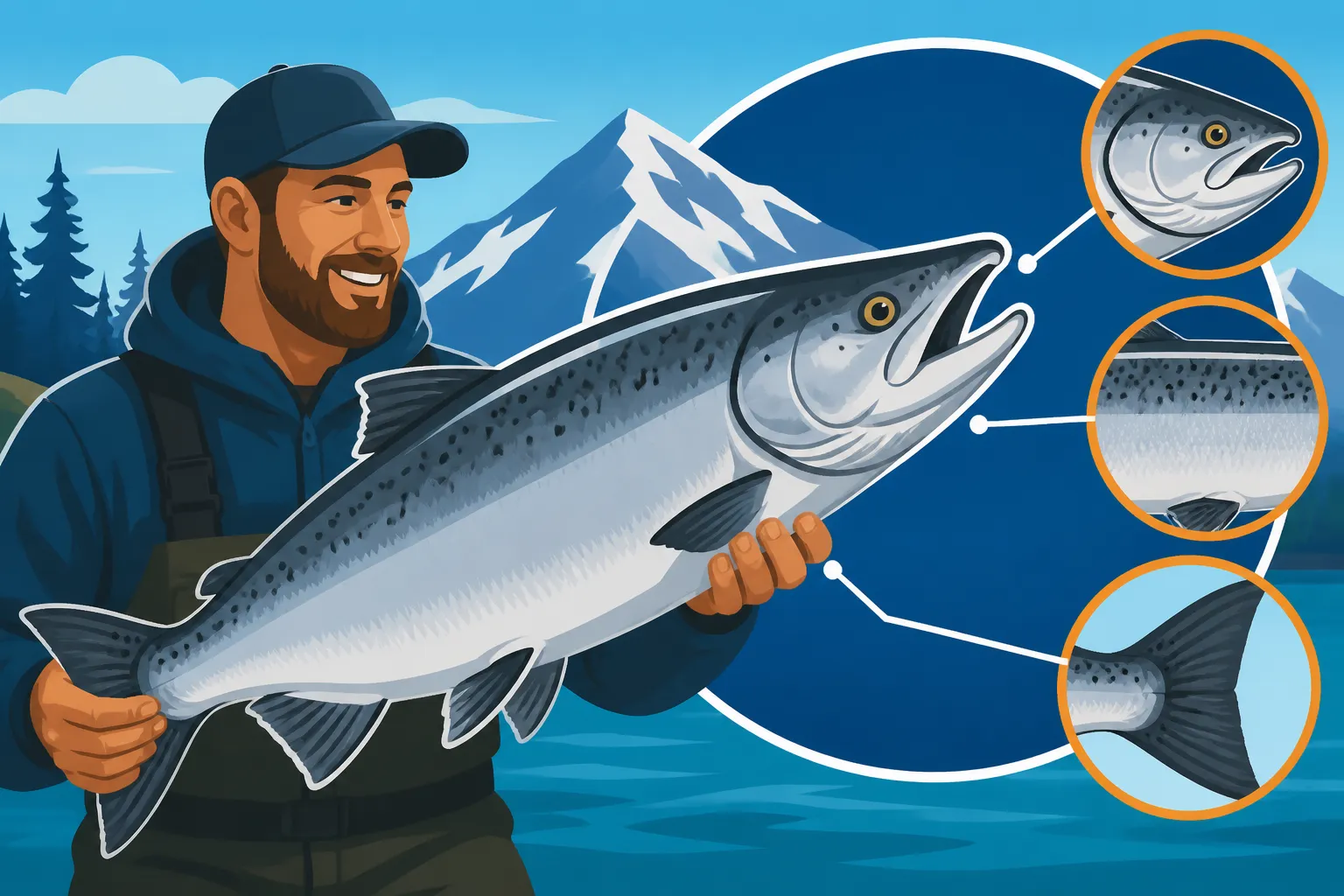
This is perhaps the most reliable and often the first feature experienced anglers check. King Salmon have a distinctly dark mouth. When you open their mouth, you'll notice that the entire inside – including the gums along both the upper and lower jaws – is predominantly black or very dark.
Contrast this with Coho (Silver) Salmon, which usually have a white or light gum line on their lower jaw. Sometimes, a King might have a small, lighter patch inside its mouth, but the overall impression will still be dark. It's not just the tongue or roof of the mouth; it's the gums that are key. This black gum line is a consistent identifier for King Salmon, whether they are fresh from the ocean or further along in their freshwater migration. Make sure to get a good look inside the mouth to confirm this crucial detail.
Tail Shape and Spotting Patterns
Another significant identifier is the King Salmon's tail (caudal fin). Kings possess a large, somewhat squared-off tail that is typically heavily spotted. The key here is that these spots are present on both the upper and lower lobes of the tail. Many other salmon species will have spots only on the upper lobe, or no spots at all. The spots on a King's tail tend to be irregular in shape and size, scattered across the entire fin.
Think of it like a painter splattering dots across a canvas – it's not a neat, uniform pattern but distinctly present on both halves of the tail. When examining the tail, gently spread it open to get a clear view. This distinct spotting on both lobes, combined with the generally square shape, is a very strong indicator that you have a King Salmon.
Body Shape and Coloration
King Salmon are built for power. They generally have a more robust, broader body shape compared to other salmon species, giving them a more "chunky" or "football" appearance, especially when compared to the sleeker Sockeye. They can also grow significantly larger than other salmon species; the largest King Salmon ever caught on rod and reel in Alaska weighed over 97 pounds! Our guide to Alaska King Salmon: Size, Season, and Where to Catch dives deeper into their impressive dimensions.
In terms of coloration, ocean-run Kings are typically a vibrant silvery color on their sides, with a darker, often iridescent blue-green or purplish back. As they enter freshwater and move closer to spawning, their coloration changes dramatically. They can take on a darker, bronze, or even reddish-brown hue. However, regardless of their migratory stage, you'll typically find small, irregular black spots on their backs and upper sides, in addition to the distinct spots on their tails. The overall impression is one of solid, powerful construction.
Fin Peculiarities
While less distinct than the mouth or tail, a few fin characteristics can also help. King Salmon often have a relatively large adipose fin (the small, fleshy fin between the dorsal and tail fins). More notably, their anal fin (the fin on the underside near the tail) is often uniformly dark or has a dark leading edge. This can sometimes be a subtle distinction, but when combined with the other primary identifiers, it adds to the overall picture. Again, it's about looking for the aggregate of features rather than relying on just one.
Differentiating King Salmon from Other Alaska Salmon
Alaska is home to five species of Pacific salmon: King (Chinook), Sockeye (Red), Coho (Silver), Pink (Humpy), and Chum (Dog). While they all share the common name "salmon," each species has unique characteristics that allow for accurate identification. Knowing how King Salmon differ from each of these is crucial. For a broader overview, check out our article How to Identify Alaska Salmon Species.
King Salmon vs. Sockeye Salmon
Sockeye Salmon, also known as Red Salmon, are distinct from Kings in several key ways.
- Size: Sockeye are generally much smaller than Kings, typically ranging from 4 to 15 pounds. Kings usually start around 15-20 pounds and go way up from there.
- Coloration: Ocean-phase Sockeye are bright silver with a blue-green back, much like a King, but they lack any significant spots on their back or tail. As Sockeye enter freshwater to spawn, their bodies turn a brilliant ruby red, and their heads become green, a dramatic transformation rarely seen to the same extent in Kings.
- Mouth and Gums: Sockeye have entirely white or very pale mouths and gums, a stark contrast to the King's black mouth.
- Tail: Sockeye tails are typically unspotted and more deeply forked than a King's squared-off tail.
- Diet: Sockeye are primarily plankton feeders in the ocean, giving them their characteristic bright red flesh, while Kings eat other fish and squid.
You can delve deeper into their specific differences with our guide on King vs Sockeye Salmon Differences.
King Salmon vs. Coho Salmon (Silver Salmon)
Coho Salmon (Silvers) are often the species most commonly confused with Kings, especially by less experienced anglers. They share some similar features but have critical differences.
- Size: Coho are smaller than Kings, typically weighing between 8 and 20 pounds. While a large Coho might approach a smaller King's size, they rarely reach the truly massive proportions of trophy Kings.
- Mouth and Gums: This is the most crucial differentiator. While Coho also have a dark mouth, their lower gum line is distinctly white or pale. Remember, Kings have black gums on both upper and lower jaws. This is the "money shot" for ID when in doubt.
- Tail: Coho tails are also spotted, but typically only on the upper lobe, not on both lobes like the King. Their tail might also be slightly more forked than a King's.
- Body Shape: Coho are generally more slender and torpedo-shaped compared to the King's more robust build. Their spots on the back are usually smaller and less pronounced than a King's.
- Coloration: Ocean-phase Coho are bright silver with a darker back. As they enter freshwater, they can take on a reddish-brown hue, similar to Kings, but usually with more distinct spotting on their back and upper sides.
For more details on differentiating between similar species, our guide on Sockeye vs Coho Salmon Differences can also be helpful, as it provides context for other comparisons.
King Salmon vs. Pink Salmon (Humpies)
Pink Salmon, often called "Humpies" due to the pronounced hump males develop on their backs during spawning, are easy to distinguish from Kings.
- Size: Pink Salmon are the smallest of the Pacific salmon, rarely exceeding 5 pounds. Kings are, of course, significantly larger.
- Mouth and Gums: Pink Salmon have white mouths and gums.
- Tail: Pink Salmon have large, oval-shaped spots covering their entire tail, which is more uniformly rounded or slightly forked than a King's. These spots are also more uniform in size.
- Body Shape: Beyond the male's distinct hump, Pinks have a more compressed body shape compared to the robust King.
- Coloration: Ocean-phase Pinks are silvery. In freshwater, they turn olive green to brownish on their back with pale bellies, and males develop the characteristic large hump.
King Salmon vs. Chum Salmon (Dog Salmon)
Chum Salmon, or Dog Salmon, are often overlooked but can be mistaken for other species.
- Size: Chum are intermediate in size, typically ranging from 8 to 18 pounds, putting them between Pinks and Sockeye, and generally smaller than Kings.
- Mouth and Gums: Like Sockeye and Pinks, Chum Salmon have white mouths and gums.
- Tail: Chum have an unspotted tail with a light colored band or ray, and it's often slightly forked. This is a clear contrast to the heavily spotted tail of a King.
- Body Shape and Coloration: Ocean-phase Chum are silvery. In freshwater, they develop striking vertical bars of purple, green, and red on their sides, a feature unique among salmon species and making them easy to identify from a King. They also have large, canine-like teeth, particularly pronounced in males.
Practical Tips for On-the-Water Identification
When you're out on the water, battling the elements and the fish, quick and accurate identification can be challenging. Here are some practical tips to help you make the right call in the moment.
Check Multiple Features
Never rely on just one characteristic. A fish's coloration can vary greatly depending on its time in freshwater, water clarity, and even lighting conditions. What looks like a dark mouth might be obscured by bait or a shadow. Always try to confirm at least two or three key features.
For a King Salmon, the absolute best combination to check is:
- Black mouth and gums: This is generally the most consistent feature.
- Spots on both lobes of a generally square tail: This is the second strongest indicator.
- Overall robust body shape and irregular spots on the back/upper sides.
Take a moment to carefully examine the fish before making a decision. It’s better to take an extra minute than to make a costly mistake.
Use a Field Guide or App
Modern technology and good old-fashioned books can be your best friends. Many waterproof field guides specific to Alaska's fish species are available online, perhaps even on platforms like Amazon, that you can keep in your tackle box or boat bag. These guides often feature clear illustrations and photographs highlighting the key differences between species.
Additionally, there are a growing number of fishing apps that can help with identification. Some even allow you to upload a photo of your catch for analysis or provide interactive keys to walk you through the identification process. Having a quick reference tool readily available can save you a lot of guesswork and stress, especially when you're unsure. You can also pick up a copy of the official Alaska Fishing Regulations Explained booklet to review the images and descriptions provided by the Alaska Department of Fish and Game.
When in Doubt, Release
This is the golden rule, folks, and it cannot be stressed enough. If you've gone through all the steps, checked all the features, and you're still not 100% sure if that salmon is a King or another species, always opt to release the fish. It's the most responsible and ethical choice. Unintentional violations of fishing regulations can carry severe penalties, including fines, confiscation of gear, and loss of fishing privileges.
Furthermore, releasing an unidentified fish contributes to conservation efforts. Given the often fluctuating populations of King Salmon, particularly in regions like the Kenai River where emergency orders can change regulations mid-season, erring on the side of caution is always best. A careful, quick release ensures the fish has the best chance of survival. Always practice Alaska Catch-and-Release Best Practices to minimize harm.
King Salmon vs. Other Salmon: A Quick Comparison
To help solidify your identification skills, here's a handy comparison table summarizing the key differences between King Salmon and other common salmon species you'll encounter in Alaska. Keep this in mind, or even bookmark this page, when you're preparing for your next trip.
| Feature | King Salmon (Chinook) | Sockeye Salmon (Red) | Coho Salmon (Silver) | Pink Salmon (Humpy) | Chum Salmon (Dog) |
|---|---|---|---|---|---|
| Mouth/Gums | Entirely black | White or pale | Dark mouth, white lower gum line | White or pale | White or pale |
| Tail Spots | Present on both upper & lower lobes | Absent | Present mostly on upper lobe | Large, oval spots over entire tail | Absent, often a light band |
| Tail Shape | Broad, slightly squared-off | Forked | Slightly forked | Rounded or slightly forked | Slightly forked |
| Body Spots | Irregular spots on back & upper sides | Absent (ocean) | Small, irregular spots on back | Large, oval spots on back | Absent, faint speckles |
| Overall Shape | Robust, deep-bodied | Sleek, streamlined | More slender than King | Compressed, pronounced male hump | Thick-bodied, prominent teeth in males |
| Average Size (lbs) | 15-50+ | 4-15 | 8-20 | 2-6 | 8-18 |
| Freshwater Color | Bronze, dark brown, reddish | Brilliant red body, green head | Reddish-brown, dark spots | Olive green to brown, large hump | Purple/green/red vertical bars |
Knowing how to accurately identify a King Salmon is a fundamental skill for any angler hoping to experience the incredible fishing opportunities Alaska offers. By focusing on the consistent features of the mouth, tail, and overall body, and by cross-referencing with other species, you'll be well on your way to confidently recognizing these magnificent fish. Remember, responsible fishing starts with correct identification, ensuring you respect the regulations and contribute to the sustainability of Alaska's precious fisheries. Enjoy the thrill of the chase, and may your next King be easily identified and celebrated!
Disclaimer
Please remember that fishing regulations, including identification criteria, bag limits, and seasons, can change frequently due to emergency orders from the Alaska Department of Fish and Game. Always consult the most current Alaska Sport Fishing Regulations booklet and check for any emergency orders before you head out on your fishing trip. This guide is for informational purposes only and should not be considered a substitute for official regulations.