Alaska Rockfish Retention and Release Rules
Navigating the world of Alaska fishing regulations can feel like trying to untangle a particularly stubborn fishing line, and when it comes to rockfish, the rules are surprisingly intricate. Many anglers, especially those new to the Last Frontier, often find themselves scratching their heads over daily limits, species identification, and the critical importance of proper release methods for these deep-dwelling fish. This comprehensive guide aims to demystify Alaska's rockfish retention and release rules, ensuring you can enjoy a responsible and successful fishing trip without inadvertently breaking any laws.
Understanding Alaska's Diverse Rockfish Species and Their Regulations
Rockfish are a fascinating and varied group of fish found in Alaska's marine waters, known for their vibrant colors and often spiny fins. However, their sheer diversity also contributes to the complexity of the regulations surrounding them. It's not just "a rockfish" to the Alaska Department of Fish and Game (ADF&G); it's a specific species, each with its own conservation status and corresponding rules.
Why Rockfish Regulations Are So Nuanced
One of the biggest reasons rockfish regulations are so detailed is the incredible number of species that call Alaskan waters home. You'll encounter everything from the common Black Rockfish to the more elusive Yelloweye, Quillback, Canary, and China Rockfish, among many others. Each of these species has different growth rates, reproductive cycles, and population sizes, which means their ability to withstand fishing pressure varies dramatically. For instance, a species like the Yelloweye Rockfish can live for over 100 years and takes a very long time to mature, making it particularly vulnerable to overfishing. This biological reality translates directly into stricter regulations for certain species while others, with healthier populations, might have more generous limits.
The challenge for anglers, of course, is quickly identifying these different species, especially when they're coming up from deep water on a fast-paced fishing trip. A misidentification can lead to accidentally retaining a prohibited fish or exceeding a sub-limit for a protected species, which can result in significant penalties. Moreover, the deep-water habitat favored by many rockfish species presents a unique physiological challenge: barotrauma. This condition, caused by rapid changes in pressure, often makes it impossible for released fish to swim back down on their own, making specific release practices mandatory.
Key Species and Their Typical Management
When you're out on the water, you'll most commonly encounter a few key rockfish species that garner specific attention in the regulations.
- Black Rockfish: Often found in shallower waters, these are generally the most abundant and have the most liberal bag limits in many areas. They're characterized by a dark, mottled grey to black body with a lighter belly, and a moderately large mouth.
- Yelloweye Rockfish: These are the rock stars (and often the regulated stars) of the group. With their vibrant orange-red bodies and striking yellow eyes, they're unmistakable. However, their slow growth and longevity make them highly susceptible to overfishing. Consequently, Yelloweye Rockfish are typically subject to very restrictive bag limits, often a sub-limit of the general rockfish allowance, or even a complete prohibition on retention in some areas. For instance, in many parts of Southcentral and Southeast Alaska, you might only be allowed to keep one Yelloweye as part of your overall rockfish limit, if any at all.
- Other Rockfish: Species like Quillback, China, and Copper Rockfish are also popular catches, and their regulations usually fall under a general rockfish bag limit, sometimes with sub-limits depending on the management area. It's truly essential to be able to tell them apart, especially if you're planning on keeping any.
Understanding these distinctions is the first step in responsible rockfish angling. Always assume the regulations are complex and verify them before you drop a line.
Essential Rockfish Retention Rules: Bag and Possession Limits
The bedrock of responsible rockfish fishing in Alaska lies in understanding and strictly adhering to the daily bag and possession limits. These aren't just arbitrary numbers; they are carefully determined by fisheries biologists to ensure the long-term sustainability of these valuable fish populations.
Daily Bag Limits and Species-Specific Restrictions
Alaska's daily bag limits for rockfish vary considerably by region and even by specific management area within a region. It's not a "one size fits all" rule. For example, in many parts of Southcentral Alaska, you might find a daily bag limit of five rockfish, but within that limit, only one or two might be a Yelloweye Rockfish. This kind of "sub-limit" is common and reflects the conservation status of particularly vulnerable species.
Before every single fishing trip, it is absolutely critical that you consult the most current Alaska Department of Fish and Game (ADF&G) sport fishing regulations booklet for the specific area you plan to fish. You can find detailed information on Alaska Fishing Regulations Explained and more specifically about your daily catch on Alaska Fishing Limits and Bag Limits Explained. Don't just rely on what you heard last year or what a friend told you; regulations can and do change, sometimes mid-season, via emergency orders, especially for sensitive species like King Salmon or certain rockfish. Many guided Alaska Fishing Charters: Complete Guide will handle this for you, but as an angler, the ultimate responsibility falls to you.
Imagine you're fishing near Seward, and the general rockfish limit is five per day, but with a sub-limit of one Yelloweye. If you catch three Black Rockfish and two Yelloweye, you've exceeded the Yelloweye sub-limit, even though your total rockfish count is five. The consequences can be severe, so meticulous attention to these details is a must.
Understanding Possession Limits
Beyond the daily bag limit, there's also the "possession limit." This is often misunderstood, but it's crucial, especially for visitors on multi-day trips or those planning to transport their catch. The possession limit refers to the total number of fish you can have in your possession at any given time, whether it's freshly caught, frozen, or in transit. For many species in Alaska, the possession limit is twice the daily bag limit.
Let's use our Seward example again: if the daily bag limit is five rockfish with a one-Yelloweye sub-limit, your possession limit might be ten rockfish total, but with a maximum of two Yelloweye. This means if you fish for two days and catch five Black Rockfish and one Yelloweye each day, you would have ten total rockfish, two of which are Yelloweye. This would be within the possession limit. However, if you fished a third day and wanted to keep more, you would first need to consume or process enough fish from your existing possession to make room under the limit before retaining any new ones.
This becomes particularly important when you're traveling. When your fish leave the immediate vicinity of the water body where they were caught and are being transported home or to a processor, they fall under possession limits. Ensure your fish are properly documented and separated if you're combining catches with others, to avoid any confusion or accidental violations.
Here's a simple table outlining general rockfish information, but remember, always check current ADF&G regulations for precise, up-to-date limits for your specific fishing area.
| Rockfish Species | General Characteristics | Typical Habitat Depth | General Regulatory Status (Check Local Regs!) |
|---|---|---|---|
| Black Rockfish | Dark, mottled gray/black, lighter belly; moderately large mouth. | Shallow-Mid (0-400 ft) | Often more liberal limits. |
| Yelloweye Rockfish | Bright orange-red, prominent yellow eyes; spiny dorsal fin. | Mid-Deep (100-1200 ft) | Highly restricted; often 1 fish sub-limit or release only. |
| Copper Rockfish | Coppery-brown, often with lighter blotches/stripes. | Shallow-Mid (0-600 ft) | Included in general rockfish limit. |
| Quillback Rockfish | Dark brown, mottled, often with yellow or orange spots; spiny dorsal. | Shallow-Mid (0-900 ft) | Included in general rockfish limit. |
| China Rockfish | Black with yellow blotches/stripes along lateral line. | Shallow-Mid (0-400 ft) | Included in general rockfish limit. |
Crucial Release Practices: Minimizing Barotrauma in Rockfish
Perhaps one of the most critical, yet often misunderstood, aspects of rockfish fishing in Alaska is the proper release of fish, particularly those caught from deeper waters. This isn't just about good sportsmanship; it's a mandatory regulation in many areas, designed to counteract the devastating effects of barotrauma.
The Dangers of Barotrauma for Deep-Water Fish
Barotrauma is a physiological injury suffered by fish (and other marine life) when they are brought quickly to the surface from significant depths. It's caused by the rapid expansion of gases in their swim bladder as the external water pressure decreases. Think of it like a diver getting "the bends," but in reverse for a fish.
The visible symptoms of barotrauma are often quite stark and distressing:
- Bulging Eyes: The eyes can protrude significantly.
- Distended Stomach: The stomach and gut cavity can swell.
- Everted Stomach: In severe cases, the swim bladder and even the stomach can be pushed out through the fish's mouth.
- Inability to Swim Down: The most critical symptom is the fish's inability to descend. With an overinflated swim bladder, they become positively buoyant, floating helplessly on the surface, making them easy prey for birds or marine mammals, or leading to eventual death from exposure or exhaustion.
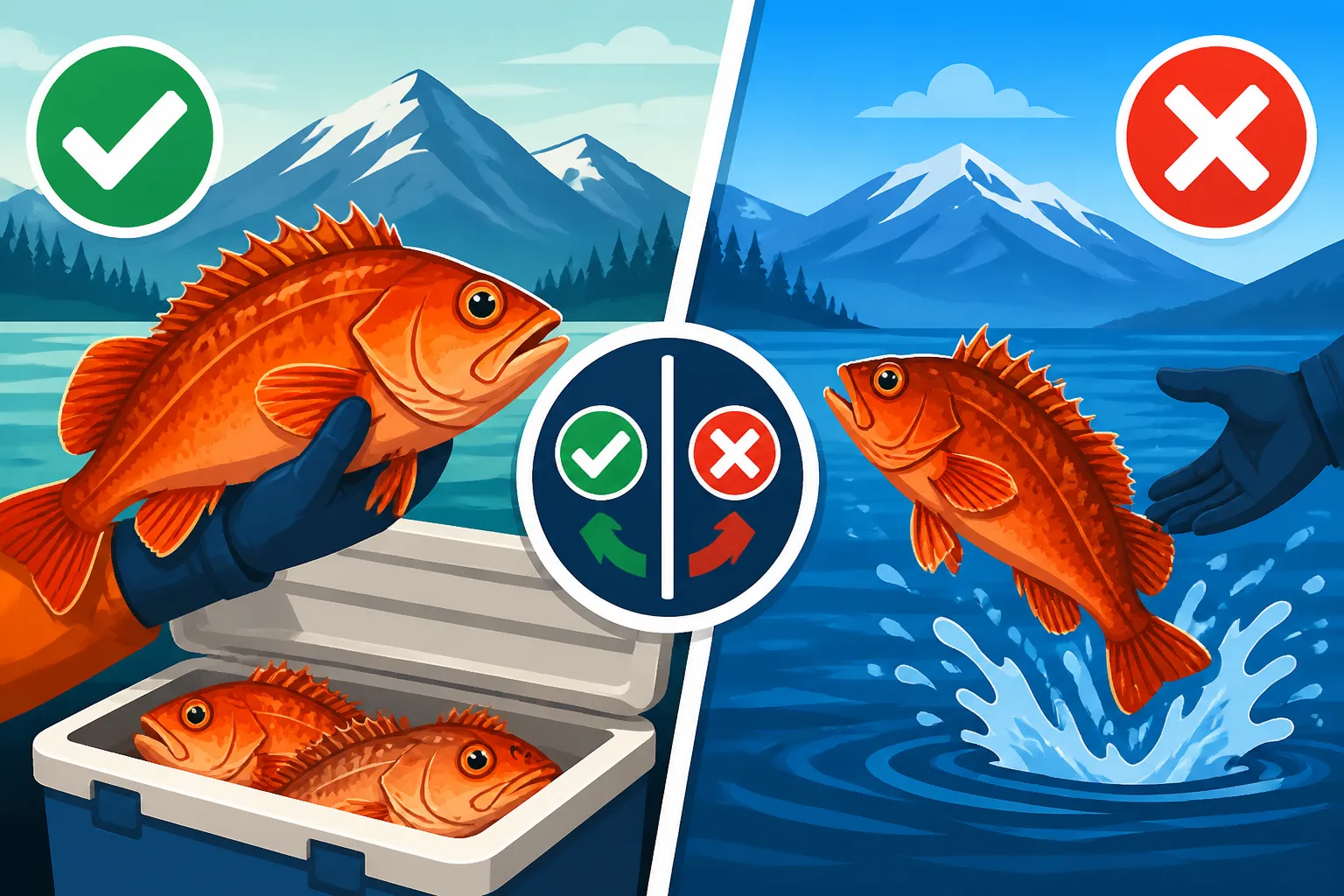
For rockfish caught from depths greater than about 60 feet (and certainly from 100+ feet), barotrauma is almost a certainty. Simply tossing these fish back into the water will, more often than not, result in their death. This is why proper release techniques are not just recommended, but legally required in many parts of Alaska to ensure the survival of released rockfish.
The Mandatory Role of Descending Devices
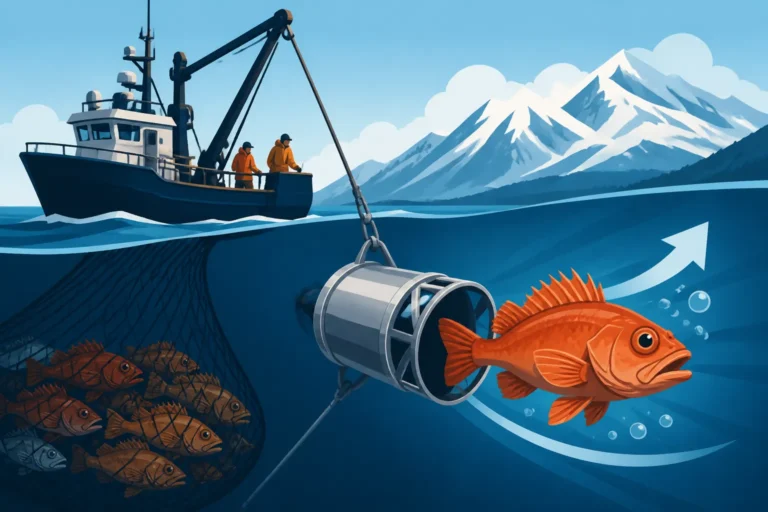
To combat barotrauma and increase the survival rate of released rockfish, Alaska regulations mandate the use of descending devices in many areas, particularly in marine waters of Southeast Alaska and the Gulf of Alaska (which includes popular fishing destinations like Homer, Seward, and Valdez). A descending device is a specialized tool designed to rapidly return a fish to the depth from which it was caught, allowing its swim bladder to recompress and the fish to recover and swim away.
These devices work by attaching the fish (usually through the lip or by cradling it) to a weighted mechanism that is then lowered back to depth. Once at the desired depth (or when the fish pulls free), the device releases the fish. You can find various types of descending devices available online, often through retailers like Amazon, or at most reputable local tackle shops throughout coastal Alaska. They come in different designs:
- Weighted Lip Clamps/Hooks: These devices clamp onto the fish's jaw or pectoral fin or use an inverted barbless hook, allowing it to be weighted and lowered. Once sufficient depth is reached, the angler gives a tug, releasing the fish.
- Cage-like Devices: Some devices are essentially small cages that hold the fish, lowering it to depth and then releasing it with a pull of a rope.
- Pressure-Activated Releases: More advanced tools can automatically release the fish once a certain pressure (and thus depth) is achieved.
It is absolutely vital that you understand and practice using a descending device correctly. For more in-depth information on their use and the specific regulations, refer to Alaska Rockfish Deepwater Release Device Rules. Having a descending device ready and easily accessible is paramount whenever you're fishing in waters where rockfish are present, especially if you're targeting bottom fish like halibut where rockfish are common bycatch.
Using a descending device effectively involves:
- Swift Action: Get the fish back down as quickly as possible. The longer it's on the surface, the worse the barotrauma.
- Gentle Handling: Minimize air exposure and handle the fish carefully.
- Target Depth: Aim to release the fish at or near the depth it was caught.
- Proper Attachment: Ensure the device is securely attached without causing further injury.
This proactive approach is essential for the conservation of rockfish populations and is a cornerstone of ethical fishing in Alaska.
Practical Strategies for Responsible Rockfish Angling
Navigating rockfish regulations successfully in Alaska isn't just about knowing the rules; it's about adopting practical strategies and habits that ensure you're always compliant and contributing to sustainable fisheries. From preparation to understanding the nuances of accidental catches, responsible angling means being prepared.
Species Identification and Preparation
The old adage "know your fish" is particularly true for Alaska rockfish. As we've discussed, misidentification can lead to serious regulatory issues. Before you even head out, take the time to familiarize yourself with the common rockfish species in your target area. Carry a laminated Alaska Fish Species Guide or a small, printed guide with you on the boat. Having clear photos and descriptions can be invaluable when you're trying to make a quick decision on a wiggly fish.
Preparation also extends to your gear. If you're fishing in waters where rockfish are common, or where deep-water release is mandatory, your descending device should be rigged and ready before your line even hits the water. Don't wait until you've got a distressed rockfish flopping on the deck to start fumbling with your release gear. Have it clipped to the rail, with enough line spooled out for the depth you're fishing, and the release mechanism easily accessible. Many anglers even carry multiple descending devices, especially on charter boats or if fishing with a group, to ensure one is always ready. You can easily find various descending devices and fishing tackle on platforms like Amazon.
Consider scenarios: you might be primarily targeting halibut, but rockfish are often bycatch. If you accidentally hook a Yelloweye Rockfish while halibut fishing, and it's from 200 feet down, you need to be ready to release it correctly if you've already met your sub-limit or if retention is prohibited. Quick action is key to its survival.
Avoiding Violations and Promoting Conservation
The best way to avoid fishing violations is to be a well-informed and proactive angler. Beyond reading the annual regulations booklet, make it a habit to check the ADF&G website for emergency orders before every trip. These orders can change bag limits, open or close fisheries, or alter specific regulations with little notice, especially during dynamic seasons like the salmon runs or when species like King Salmon are struggling. A good habit is to check the ADF&G emergency orders often. You can learn more about how to navigate these changes in our guide on How to Read Alaska Fishing Regulations Booklet.
Violating Alaska's fishing regulations can result in significant penalties, including hefty fines, forfeiture of gear, and even loss of fishing privileges. For more details on what can happen, check out our article on Alaska Fishing Violations and Fines. It's simply not worth the risk.
Beyond legal compliance, responsible angling practices promote the health of the fishery. Using circle hooks when bait fishing for rockfish (or other bottom fish) can greatly reduce the incidence of deep hooking, making it easier to release fish unharmed. Employing catch-and-release best practices, as outlined in guides like Alaska Catch-and-Release Best Practices, for all species you don't intend to keep, contributes to the overall sustainability of Alaska's rich aquatic resources. Even for species that don't suffer from barotrauma, minimizing handling time, keeping them in the water as much as possible, and using appropriate tools are crucial.
Gear Considerations for Rockfish Fishing
While rockfish aren't always the primary target, if you're engaging in general saltwater bottom fishing in Alaska, having appropriate gear is wise. Heavy jigs, robust rods with good backbone, and braided line are standard for getting baits and lures down to depth and managing the fight with strong bottom fish.
Crucially, as mentioned, have your descending device. Whether it's a simple weighted barbless hook or a more elaborate spring-loaded clamp, make sure it's accessible and you know how to use it proficiently. Many Alaska Halibut Charter Regulations Explained will discuss the mandatory use of descending devices, as rockfish are frequently caught as bycatch. If you're running your own boat or even joining friends, it's a good idea to ensure someone has a spare. Having one from Amazon stowed away for emergencies is never a bad idea.
Furthermore, if you're also targeting Lingcod, which often inhabit similar rocky structures as rockfish, be aware that Alaska Lingcod Fishing Regulations and Limits also have their own specific rules regarding seasons, size, and bag limits. Always be prepared for multiple species.
By understanding the species you might encounter, being prepared with the right equipment, and diligently following all regulations, you can ensure your Alaska rockfish fishing experience is both rewarding and responsible.
Disclaimer
Please note that fishing regulations in Alaska are subject to change by emergency order throughout the season. It is the angler's responsibility to check the most current Alaska Department of Fish and Game (ADF&G) regulations and emergency orders for the specific area they plan to fish before heading out on the water. This guide is for informational purposes only and should not be considered a substitute for official regulatory documents.